



Starting on Monday, all travelers entering Beijing from overseas were required to be quarantined at designated sites for 14 days.
A 1,000-bed former SARS treatment hospital in Beijing was reopened for imported COVID-19 cases.
BEIJING, March 16 (Xinhua) -- China has imposed stricter screening and quarantine measures on travelers entering the border through flights, trains, ships and roads as coronavirus cases soared around the world.
Across checkpoints, passengers are subject to temperature screening, health declaration and epidemiological investigations. Those with fever or other suspected symptoms will immediately be sent to designated hospitals.
In Beijing, a 1,000-bed hospital used in 2003 to treat SARS patients were re-launched Monday to mainly accommodate suspected COVID-19 patients coming from overseas and treat them once they test positive. All inbound travelers to the Chinese capital, meanwhile, were required to go through a 14-day quarantine at designated sites.
The measures were taken as overseas cases have outstripped domestic cases in China where rigorous containment is turning the tide.
"Preventing imported cases has become a key task of China's epidemic prevention and control work," said Wang Jun, an official of the General Administration of Customs, at a press conference in Beijing.
"We must resolutely curb the spread across the border," he said.
More than 83,000 confirmed cases of COVID-19 have been reported outside China as of Monday morning, the World Health Organization said, noting that the virus has spread to 146 countries and regions worldwide so far.
Health authorities said 12 out of the 16 new confirmed cases across the Chinese mainland on Sunday were from overseas. By the end of Sunday, China had reported 123 imported cases.
Wang said stricter quarantine measures are being taken onboard planes, trains and ships that have been to hard-hit countries and regions over the past two weeks.
Air China has demanded all international flights to take several rounds of temperature screening for passengers, set up separate areas for those who show symptoms during the flight, and increase the cleaning and disinfection of planes. Flight crews must wear masks, gloves and goggles and ensure passengers wear masks throughout the flight, according to the company.
Since the WHO declared COVID-19 has characteristics of a pandemic on March 11, China's daily border entries had plunged to around 120,000 people, decreasing more than 80 percent from the same period of last year, said Liu Haitao, an official of the National Immigration Administration.
About 20,000 people flew into China every day, Liu said, adding that around 10 percent were foreigners.
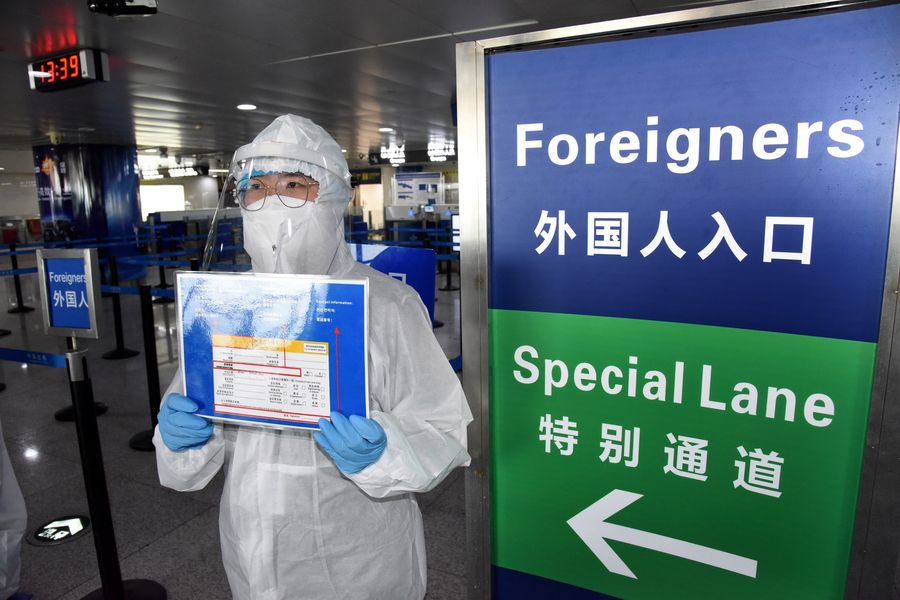
A staff member reminds foreigners to fill in an arrival card at Qingdao Liuting International Airport in Qingdao, east China's Shandong Province, March 5, 2020. (Xinhua/Li Ziheng)
PASSENGER-ROUTING EXHIBITION CENTER
International mega-cities such as Beijing and Shanghai are at the forefront of curbing imported COVID-19 cases.
Beijing recorded six confirmed cases from overseas in just 14 hours on Monday.
Starting on Monday, all travelers entering Beijing from overseas were required to be quarantined at designated sites for 14 days, Beijing municipal government official Chen Bei said.
Only people with special circumstances that pass rigorous assessment can be granted self-quarantine at home, she added.
International flight passengers arriving in Beijing were screened for fever and cough at the airport, and those who did not show symptoms were routed to an exhibition center, about 8 km away from the airport, for further checks before heading to various quarantine sites.
As shuttle buses stopped in front of the New China International Exhibition Center, health workers in hazmat suits checked the passengers' temperatures and guided them to two halls cleared for routing services.
"No winter lasts forever, and spring is sure to follow," says a banner hanging on the wall where the smell of disinfectants lingers in the air.
People were seated over one meter apart from one another.
"I will be sent to a designated hotel for quarantine," said a passenger surnamed Huang, who came to Beijing from Tokyo. "I am very assured about this arrangement, which can prevent possible cross-infection risk."
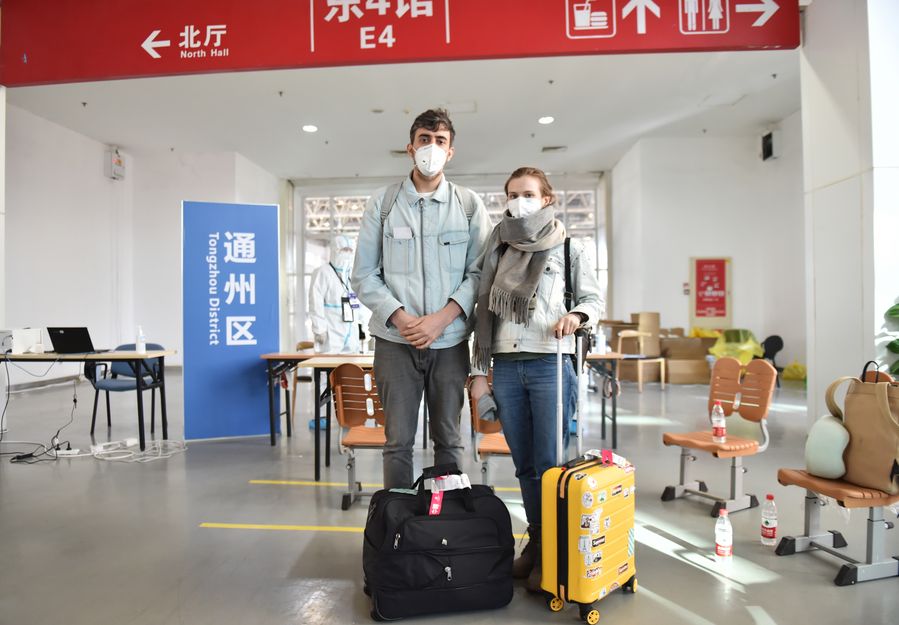
Two Russian passengers are seen at the New China International Exhibition Center in Beijing, capital of China, March 14, 2020. (Xinhua/Chen Zhonghao)
Volunteers were called in to provide translation in a number of languages.
"I'm proud to make my contributions at this special time," said Zhang Shuang, a college student volunteer.
Wu Guo'an, vice president of the Beijing Ditan Hospital, a designated institution treating the COVID-19, said the hospital had received 973 flight passengers for screening between Feb. 29 and March 14. Among them, 23 people tested positive.
"They are in stable condition. Two of them with mild symptoms have been discharged after recovery," Wu said.
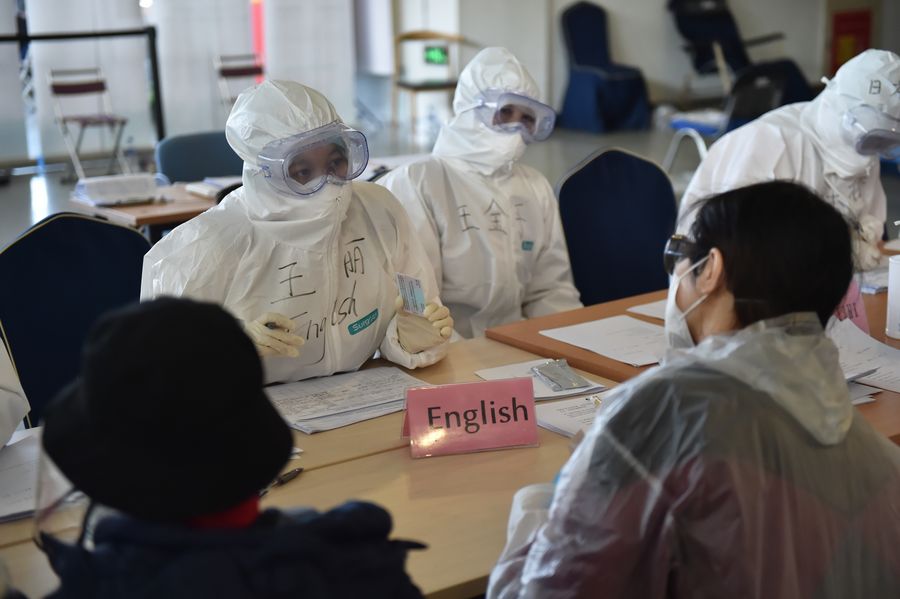
Staff members inquire information of passengers at the New China International Exhibition Center in Beijing, capital of China, March 14, 2020. (Xinhua/Chen Zhonghao)
Beijing on Monday put the 1,000-bed Xiaotangshan Hospital into use for screening imported suspected cases and treating confirmed cases who are not in severe condition.
The hospital, located in the city's northern suburb, was originally built to treat SARS patients in 2003. Hundreds of medical professionals from various departments, including respiratory, infectious disease, intensive care, pediatrics, radiology and traditional Chinese medicine, are now tasked with running it for the COVID-19 epidemic.
FINANCIAL, LEGAL CONSEQUENCES
Chen, the Beijing official, made it clear that inbound travelers need to pay for quarantine expenses themselves.
Both Beijing and Shanghai said those diagnosed with COVID-19 after returning from overseas have to pay their own treatment bills if they are not covered by either the country's medical insurance or commercial ones.
Those who have difficulties may receive medical aid, officials said.
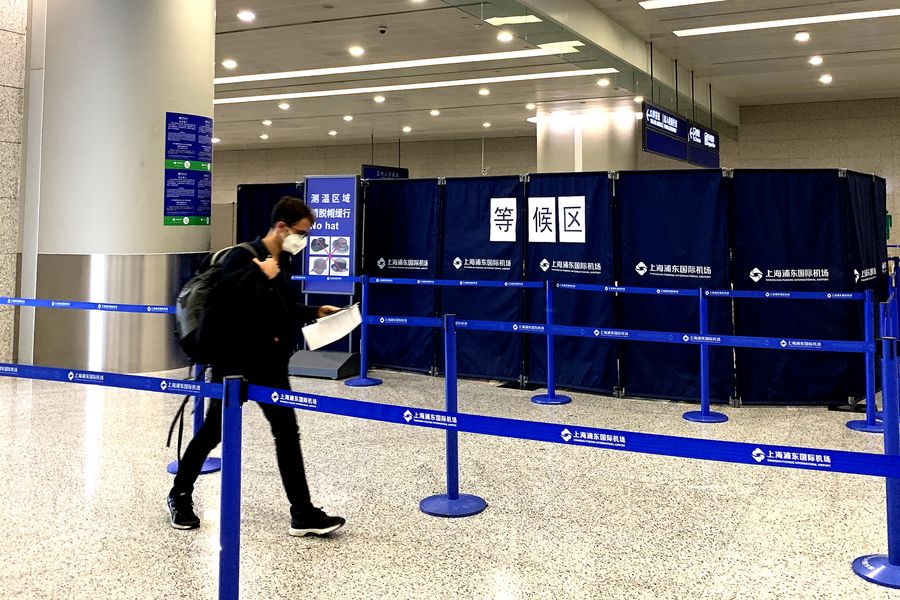
A passenger walks into the waiting area for temperature check and information registration at the Shanghai Pudong International Airport in Shanghai, east China, March 15, 2020. (Photo by Yuan Quan/Xinhua)
People who flout the border quarantine will also face serious legal consequences.
In a high-profile case, a 37-year-old woman is under criminal investigation for obstructing infectious disease prevention after returning to Beijing from Los Angeles last week.
The woman surnamed Li had been living in Massachusetts, the United States. She flew to Beijing with her family to seek treatment after one of her U.S. colleagues tested positive for COVID-19. Li also had a fever.
She tested positive after arriving in Beijing and is now being treated, according to Pan Xuhong, an official with the Beijing police. Her husband and son are under quarantine.
Pan said the police will continue to crack down on reporting false health conditions and other illegal acts that violate epidemic prevention and control measures.
According to a guideline issued on Monday, people infected with quarantinable infectious diseases who refuse to receive isolated observation or fail to truthfully fill out their health declaration forms at border checkpoints could face criminal penalties.
According to China's Criminal Law, whoever violates the provisions on frontier health and quarantine inspection and causes the spread or a grave danger of the spread of a quarantinable infectious disease may face a maximum prison term of three years.
The guideline asked public security authorities to promptly handle related cases in accordance with the law and fast-track and expose such criminal activities during the COVID-19 prevention and control period to have a strong deterrent effect.
(Video reporters: Xia Zilin, Zhao Xu, Chen Zhonghao; Video editor: Li Ziwei)■
