
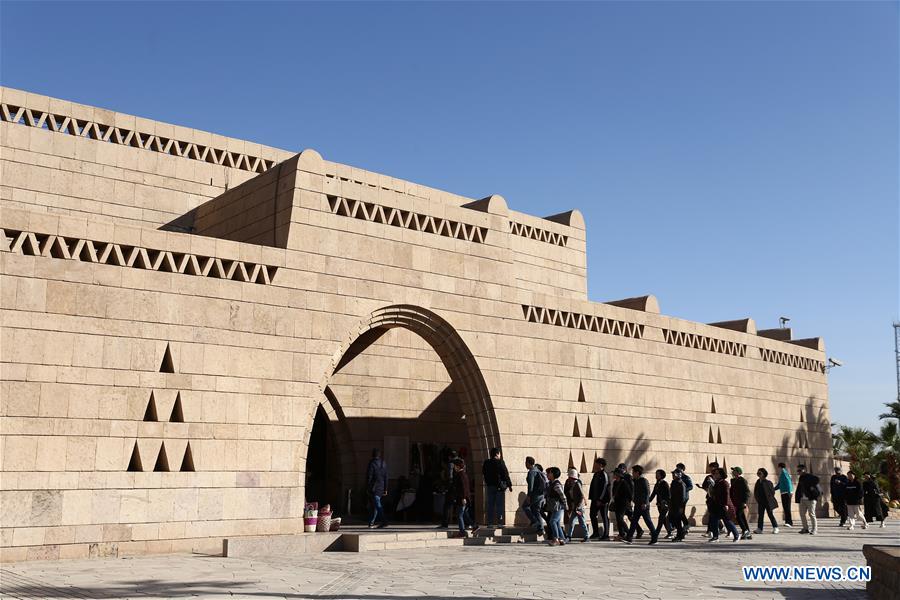
Visitors walk towards the entrance of the Nubia Museum in Aswan, Egypt, on Feb. 10, 2020. The Nubia Museum in Upper Egypt's charming city of Aswan by the Nile River is considered by architects and archeologists a piece of art that displays artifacts linking between the ancient Egyptian pharaohs and the Nubian culture and civilization. (Xinhua/Ahmed Gomaa)
by Mahmoud Fouly
ASWAN, Egypt, Feb. 19 (Xinhua) -- The Nubia Museum in Upper Egypt's charming city of Aswan by the Nile River is considered by architects and archeologists a piece of art that displays artifacts linking between the Ancient Egyptian pharaohs and the Nubian culture and civilization.
Opened to visitors in 1997, the museum was built by an initiative from the United Nations Educational, Scientific and Cultural Organization (UNESCO) during its salvage operation from 1960 to 1980 to rescue and relocate ancient Egyptian treasures from flood risks and pave the way for the construction of Aswan High Dam.
Built on a steep cliff, the total area of the museum is 50,000 square meters, 7,000 of which are dedicated to the building, while the rest are devoted to gardens. It is meant to document the culture, heritage and history of the Nubians, an ethno-linguistic group in southern Egypt.
The Nubia Museum features Egyptian antiquities dating back to Geological, Pharaonic, Roman, Coptic and Islamic ages and is considered the only museum in Egypt that contains both artifacts and an ethnographic exhibition of cultural heritage.
"The museum contains about 3,000 artifacts, including those displayed in the exhibition halls or the museum garden or those in the storehouses," said Hosni Abdel-Rahim, manager of Nubia Museum.
Abdel-Rahim explained that the museum displays artifacts narrating the story of the Nubia people since the prehistoric periods until they had to evacuate their villages for the High Dam construction.
Once visitors enter the museum's external gate, the garden receives them with a displayed obelisk engraved with Hieroglyphic text and surrounded by four baboons of sandstone, dating back to the 19th Dynasty that ruled ancient Egypt some 3,200 years ago.
After passing the main door, a short stairway in the entrance takes visitors down to the fence of the central exhibition hall, which has a large eight-meter-tall statue of King Ramses II standing in the middle. The magnificent statue is the first eye catchy thing visitors can see from a distance once they get inside the museum.
The main hall also contains Pharaonic artifacts including a baboon-like sandstone statue of god Thoth from the 19th Dynasty, a quartzite statue of Horemakhet, a high priest from the 25th Dynasty, a limestone statue of Senbebu, a prince and governor from the 12th Dynasty, a statuette of goddess Isis suckling young god Horus from the Late Period, and several others.
"The museum is designed according to international standards. It has ramps leading to the main hall instead of stairways to help visitors with wheelchairs. The walls and ceilings are plain and undecorated to keep the focus on the displayed objects," the Nubia Museum's manager told Xinhua at his office in the museum.
The museum, which won the Aga Khan Award for Architecture in 2001, was designed by Egyptian architect Mahmoud el-Hakim and carried out by Egyptian fine artists and archeologists, according to Abdel-Rahim.
It has no outlets for external lights or sunrays to avoid harming the artifacts and it contains a library in the ground floor and a restoration center in the basement.
"We call on the Egyptian Tourism and Antiquities Ministry to include the Nubia Museum on the country's tourism map due to its significance, and it would also add an extra night for tourists' stay in Aswan," said the museum's manager.
The museum is divided into several sections, each showcasing a phase of Nubian history since prehistoric times to the Kush Kingdom until the times of Christian Nubia and Islamic Nubia.
Many of the displayed artifacts were recovered from Lake Nasser in Aswan during the UNESCO 20-year salvage project. Among them are Nubian antiquities including statues, mummies, amulets, tools, jewelry, pottery and more.
Opposite to the main exhibition hall, an entire section is dedicated to display an ethnographic exhibition of Nubian cultural heritage.
It features human-size models of Nubian homes and traditional activities such as a Nubian farmer using a waterwheel, two Nubian women sitting on a bench outside their home, Nubian children learning in an outdoor class, a Nubian wedding, etc.
"This part of Nubian heritage is the focus of Aswan visitors, while foreign tourists are so much attracted to the displayed Pharaonic items," said Kamal Youssef, a curator at the Nubia Museum.
"The statue of King Ramses II in the middle of the main hall is a masterpiece, for Ramses II combined both the Pharaonic and Nubian cultures and he got married to Queen Nefertari, which was of a Nubian origin," the curator told Xinhua.
The Nubia Museum attracts dozens of Egyptian and foreign tourists every day; some of them have visited it more than once.
"I was attracted by the Nubian heritage the most. The Nubian people sacrificed and moved from their villages to allow the High Dam construction. So, the Nubia Museum is a sign of gratefulness to them," said Ibrahim Salah, an Egyptian accountant in his 30s who has been touring the museum with his wife.
"It's my first time to visit this comprehensive museum that combines Pharaonic, Nubian, Coptic and Islamic artifacts," the Egyptian visitor added.
As for Diane Hagner, an American tourist in her 50s, she described the museum as "very nicely laid out" because it collects the Nubian artifacts together through a journey of development throughout time.
"This is our second visit to the Nubia Museum. The way it is laid out takes you through all the periods as things developed. So, it's like you're going through time forward from back then to now. It's really amazing," the American lady told Xinhua.
