



With a long-cherished Chinese space dream, China's largest carrier rocket Long March-5 made a successful flight Friday evening, laying the foundation for a series of future space projects for China including exploring Mars, returning moon samples and constructing its own space station.
By Xinhua writers Yu Fei, Quan Xiaoshu
WENCHANG, Hainan, Dec. 28 (Xinhua) -- With a long-cherished Chinese space dream, China's largest carrier rocket Long March-5 made a successful flight Friday evening, inspiring China to explore deeper into space.
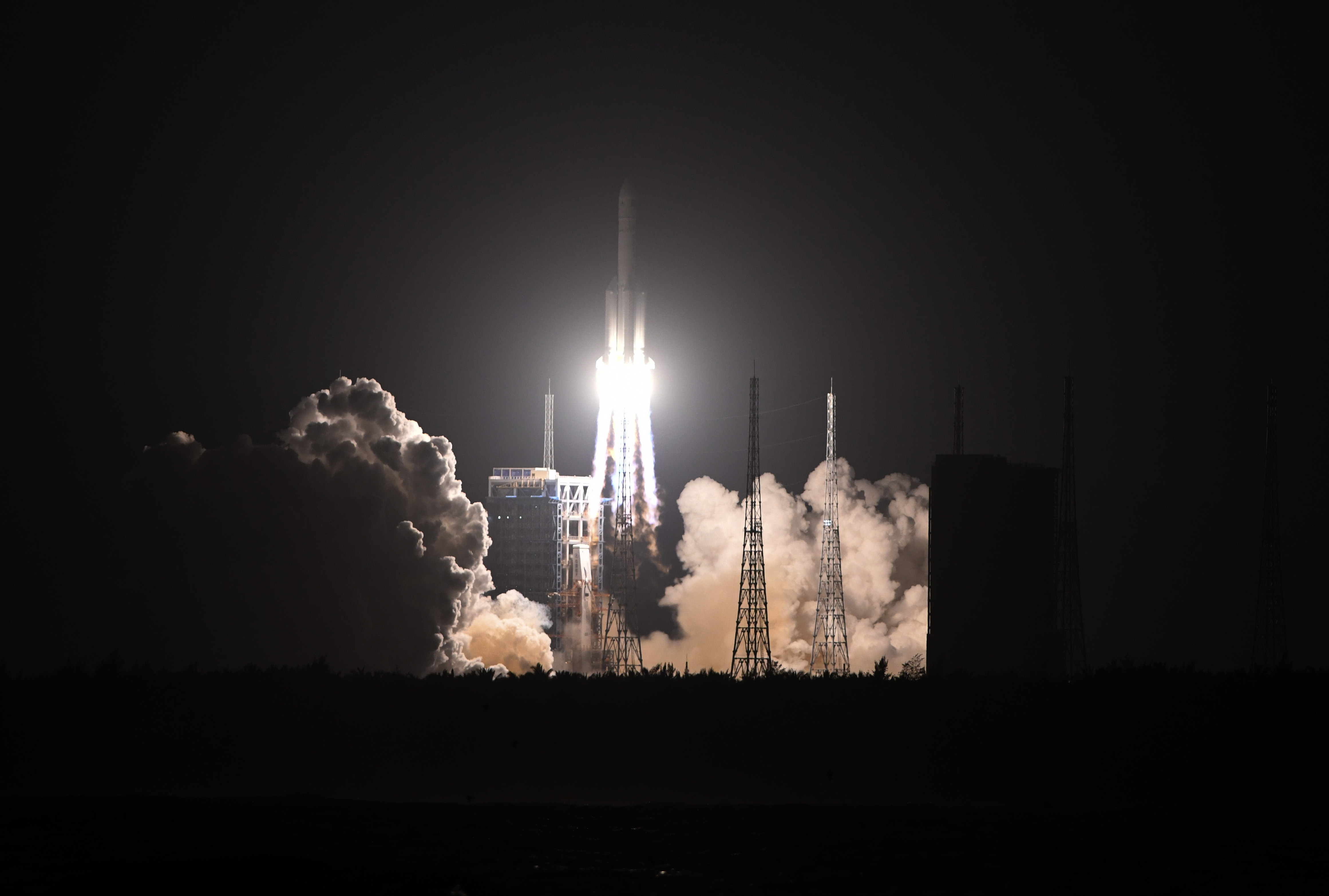
Carrier rocket Long March-5 Y3 blasts off from Wenchang Space Launch Center in south China's Hainan Province, Dec. 27, 2019. (Xinhua/Yang Guanyu)
After suffering a failure two years ago, the new Long March-5 rocket soared into the sky like a reborn phoenix from the Wenchang Space Launch Center on the coast of southern China's tropical island province of Hainan at 8:45 p.m. (Beijing time), trailing a huge flame as bright as the sun, lighting up the clouds and sea.
The rocket, coded as Long March-5 Y3, sent the 8-tonne Shijian-20 technological experiment satellite, China's heaviest and most advanced communications satellite, into its planned orbit.
The success signifies that the carrying capacity of China's launch vehicles has reached the forefront of the world.
Wu Yanhua, deputy director of the China National Space Administration, said the success of the flight lays the foundation for a series of future space projects for China including exploring Mars, returning moon samples and constructing its own space station.
The Long March-5 made its maiden flight on Nov. 3, 2016, from Wenchang. However, the second large rocket, Long March-5 Y2, suffered a failure, as a malfunction occurred less than six minutes after its liftoff on July 2, 2017.
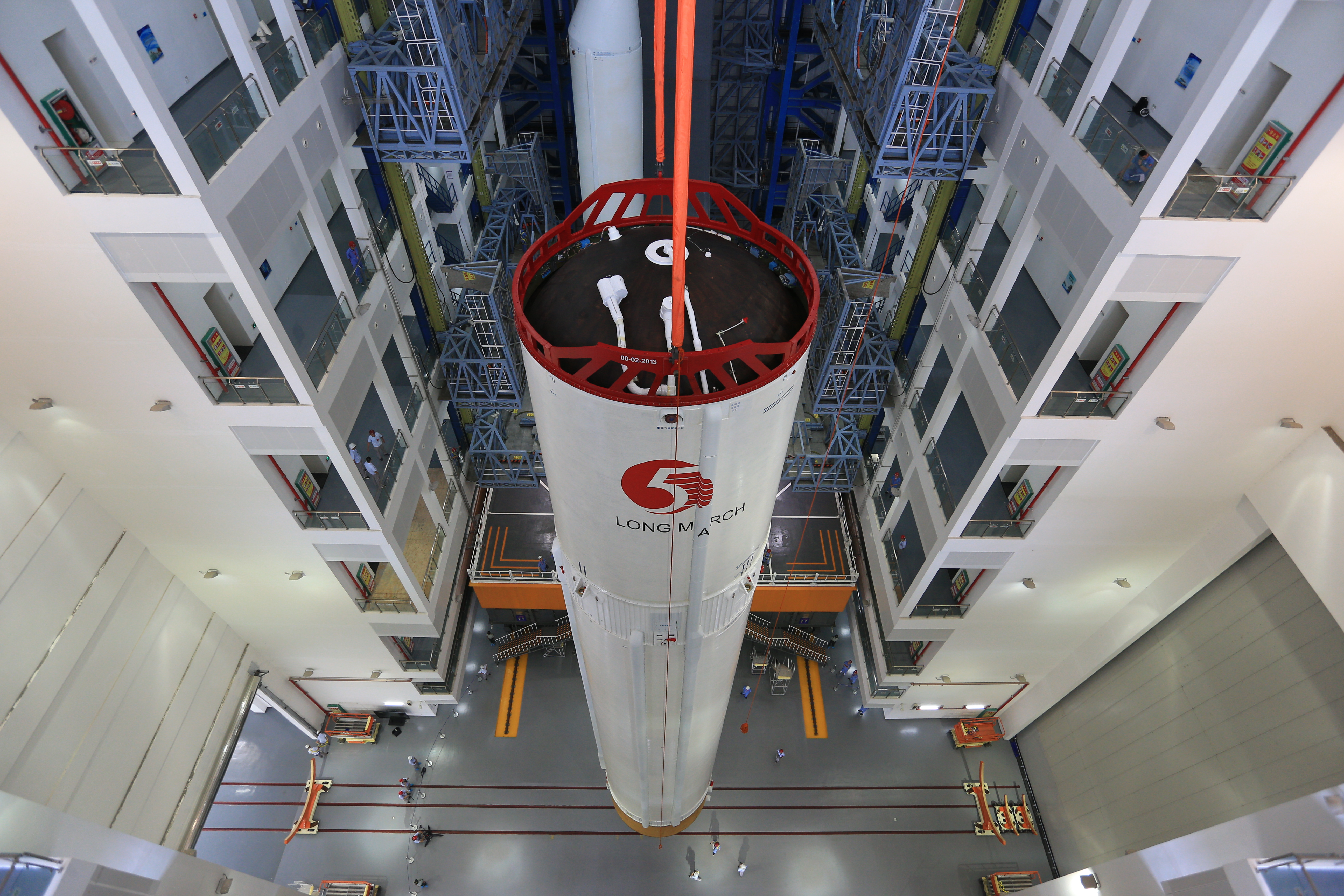
A component of carrier rocket Long March-5 Y3 is being lifted at a plant on Nov. 7, 2019. (Photo by Tu Haichao/Xinhua)
The research team discovered that the failure was caused by a problem in the engine of the first core stage of the rocket. "We have made improvements to the design, materials and technologies of the engine," said Li Dong, chief designer of the Long March-5 rocket from the China Academy of Launch Vehicle Technology (CALT) under the China Aerospace Science and Technology Corporation.
Qu Yiguang, deputy general director of the Long March-5 Y3 research team, said, "Under great pressure, the research team has put all the wisdom and efforts into the rocket over the past two years. We are very proud that we can participate in the development of the Long March-5, which represents the highest level of China's rocket technology."
After over two years of silence in Wenchang, Chinese welcomed the return of the "king" with excitement.

Carrier rocket Long March-5 Y3 is being vertically transported to the launching area of Wenchang Space Launch Center in south China's Hainan Province, Dec. 21, 2019. (Photo by Tu Haichao/Xinhua)
The Long March-5 is a large, two-stage rocket, capable of carrying a payload of 25 tonnes into low Earth orbit, 14 tonnes to geostationary transfer orbit or 8 tonnes to Earth-Moon transfer orbit, over twice the capacity of the current main Long March series rockets.
The rocket uses environmentally friendly fuel, including kerosene, liquid hydrogen and liquid oxygen, rather than highly toxic propellants.
The carrying capacity of the Long March-5 rocket equals that of other mainstream large-scale rockets in the global industry, greatly improving China's ability to launch spacecraft and laying the foundation for developing new-generation carrier rockets and heavy-lift launch vehicles, said Wang Xiaojun, head of the CALT.
As a milestone project upgrading China's launch vehicles, the development of the Long March-5 covered the most diversified engineering technologies and overcame the most difficult problems in the country's carrier rocket history, completing a massive scale of tasks along the way.
The Long March-5 rocket, with completely independent intellectual property rights, uses more than 200 key technologies.
It is more complex than any previous Long March rocket, and its design workload was more than 3.5 times that of previous projects. China also built the largest simulation laboratory in Asia for its tests.
Advanced digital technologies were applied in the design, analysis and tests of the Long March-5 rocket, which greatly shortened the development cycle and decreased costs.
More than 10,000 space engineers participated in the design, research and development of the Long March-5, which lasted for more than 10 years.
Friday's launch marks the end of a fruitful year for China's aerospace sector.

Left part of the combo photo shows the lander of the Chang'e-4 probe taken by the rover Yutu-2 (Jade Rabbit-2) on Jan. 11, 2019, and right part shows the rover Yutu-2 taken by the lander on Jan. 11, 2019, after the Chang'e-4 probe realized the first-ever soft-landing on the far side of the moon. (China National Space Administration/hand out via Xinhua)
In January, China's Chang'e-4 probe made the first-ever soft landing on the moon's far side. In June, a rocket lifted off from a mobile platform in the Yellow Sea, completing the country's first offshore launch. In August, China's new commercial carrier rocket Smart Dragon-1 made its maiden flight.
China also completed the deployment of the core BeiDou Navigation Satellite System (BDS) constellation by sending 10 BDS satellites into space in 2019. Lately, it released the first batch of 3D images based on the data from Gaofen-7, the country's first civil-use optical transmission 3D surveying and mapping satellite that reaches the sub-meter level.
Since the Long March-1 sent China's first satellite into space nearly 50 years ago, the Long March series rockets have completed 323 flights.
In the past two years, China has had over 60 space launches, with a success rate of about 96 percent.
Over the past few decades, China's launch vehicle technology has been greatly improved with the ability to launch different types of spacecraft into different orbits.
The extent of space exploration is determined by the carrying capacity of launch vehicles.
The Long March-5 carrier rocket is a prerequisite for a series of China's major space programs in the future.
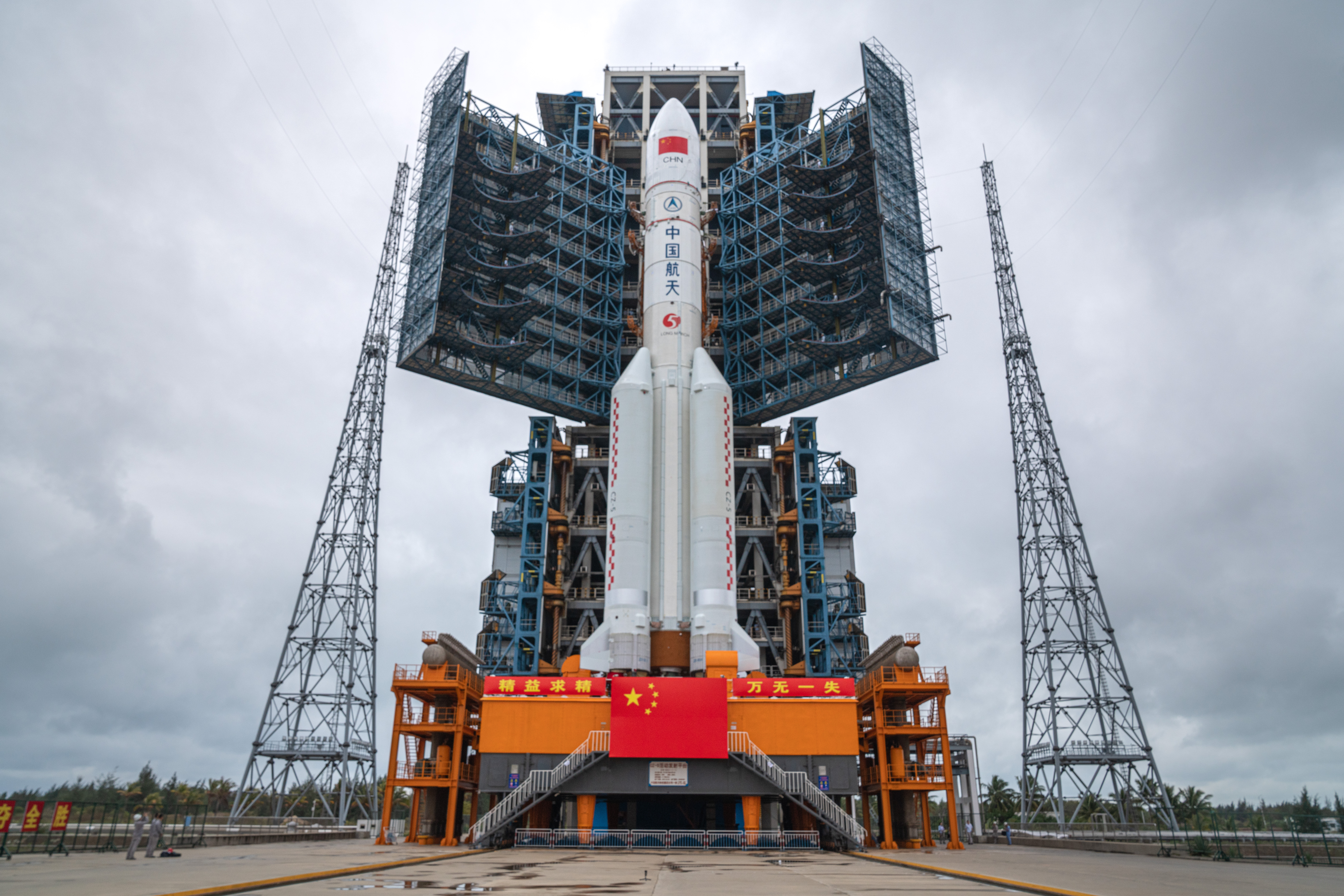
Carrier rocket Long March-5 Y3 is being vertically transported to the launching area of Wenchang Space Launch Center in south China's Hainan Province, Dec. 21, 2019. (Photo by Guo Wenbin/Xinhua)
With the success of the Long March-5 Y3 rocket, China will see a busy year in space activities in 2020.
One of the highlights in 2020 will be the launch of China's first Mars probe by using the Long March-5 rocket. China aims to complete orbiting, landing and roving on the red planet in one mission.
China's current lunar exploration program includes three phases: orbiting, landing and returning. The first two phases have been accomplished, and the next step is to launch the Chang'e-5 probe to collect moon samples and bring them back to Earth.
The Chang'e-5 probe, weighing over 8 tonnes, is expected to be launched by Long March-5 in 2020.
China plans to complete the construction of its space station around 2022. A modified version of the new rocket, Long March-5B, will be used to build the space station. And the Long March-5B is expected to make its maiden flight in 2020.
In addition, two new-generation rockets, Long March-7A and Long March-8, are also expected to make their maiden flights next year.
China is also studying and drawing up longer-term space exploration plans including probing asteroids and the Jupiter system and setting up a scientific research station on the moon's south pole.
Those missions require more powerful launch vehicles. Experts say the Long March-5 will also lay the foundation for future rockets with heavier payload capabilities.■
(Video reporters: Wang Junfeng, Zhou Xuan, Yue Xitong, Guo Liangchuan, Liu Chang, Deng Chimin, Zhou Lunjie, Liu Changlian, Gao Jie, Xu Binru, Lu Zhiyue; Video editors: Wang Han, Liu Ruoshi)
