




The south-to-north water diversion project, the world's largest, was designed to take water from China's longest river, the Yangtze, through eastern, middle and western routes to feed dry areas in the north. Over the past five years, the middle and eastern routes of the project have benefited more than 120 million people.
BEIJING, Dec. 11 (Xinhua) -- For 67-year-old farmer Zhang Qinhu, the highlight of the past five years is that he and his fellow villagers have bid farewell to muddy well water.
"It was hard to descale kettles, so we had to frequently buy new devices in the past. Thanks to a canal, we can get cleaner, safer drinking water now," said Zhang from a village in the city of Jiaozuo, central China's Henan Province.
The canal he mentions runs for 1,432 km, roughly the distance from New York to Orlando, Florida. It is the main part of the middle route of the south-to-north water diversion project, the world's largest.
The project was designed to take water from China's longest river, the Yangtze, through eastern, middle and western routes to feed dry areas in the north.
The middle route is the most attention-grabbing of the three due to its role of bringing water to the Chinese capital, and it started supplying water on Dec. 12, 2014. The first phase of the eastern route started operation in November 2013.
Over the past five years, the middle and eastern routes of the project have benefited more than 120 million people, according to the Ministry of Water Resources.
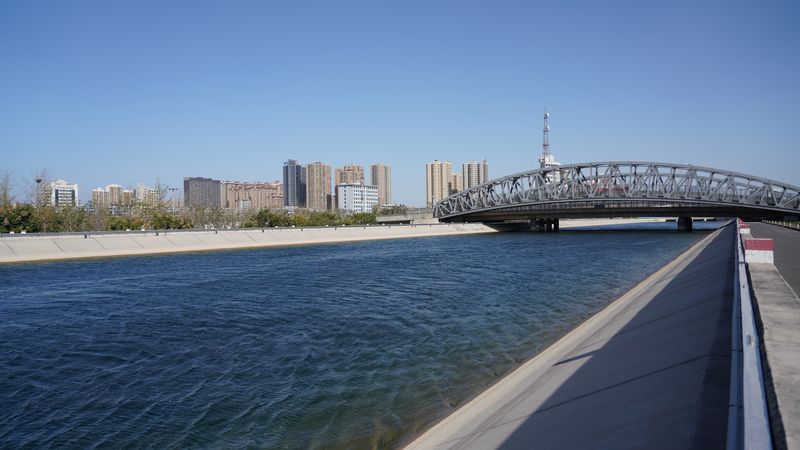
The canal of middle route of the south-to-north water diversion project in Jiaozuo, central China's Henan Province, Nov. 13, 2019. (Xinhua/Ma Xiaodong)
BRINGING CLEAN WATER TO NORTH
In a lab in northwestern Beijing, Wang Xiaoyu is busy monitoring and analyzing data related to the quality of water from the south. Besides monitoring devices, the center where Wang works also uses luminous bacteria and fish as indicators of water quality.
"Water from the south is very important for Beijing residents. We must be very cautious, keeping watch on each abnormal data fluctuation," Wang said.
The water from the Danjiangkou Reservoir in central China's Hubei Province gushes north by canal and pipeline and runs across Henan and Hebei provinces before reaching the water treatment plants of Beijing and Tianjin.
More than 70 percent of tap water in Beijing's main urban areas is from Danjiangkou, benefiting over 12 million residents, nearly half of the city's total population.
Beijing's annual water consumption had been about 3.6 billion cubic meters. But with local supplies at only about 2.1 billion cubic meters, the capital faced a shortfall of 1.5 billion cubic meters every year, which had been met largely through groundwater extraction.
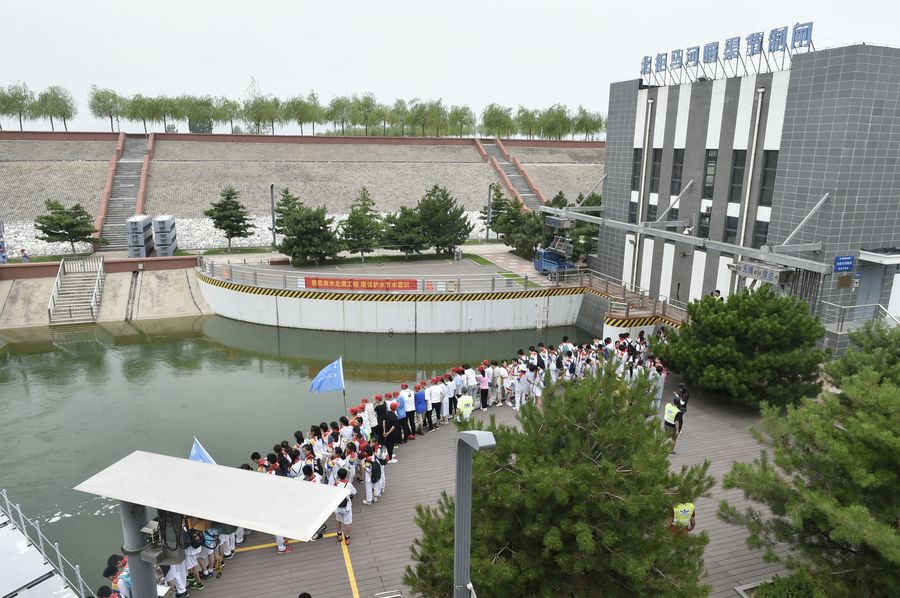
Students visit a part of the middle route of the south-to-north water diversion project in Fangshan District of Beijing, capital of China, July 9, 2019. (Xinhua/Lu Peng)
The diverted water has replenished the city's water resources and ensured the security of water supply, said Wang Junwen, deputy director with Beijing water resources control center.
The project has seen the city's per capita water resources increase from 100 cubic meters to 150 cubic meters. Meanwhile, by the end of October, the average depth of the underground water in Beijing's plain areas stood at 22.78 meters, 2.88 meters higher than that before the diverted water flowed to Beijing.
China's densely-populated northern region has long suffered acute water shortage, leading to groundwater overexploitation and river water shrinking.
To optimize the allocation of water resources and quench the thirsty north, the idea of diverting water from the resource-abundant south to the north was first envisioned by China's late leader Mao Zedong in the early 1950s.
"Over the past five years, the middle route of the water diversion project has yielded remarkable social and ecological benefits," said Yin Yanfei, an official with the Construction and Administration Bureau of South-to-North Diversion Middle Route Project.
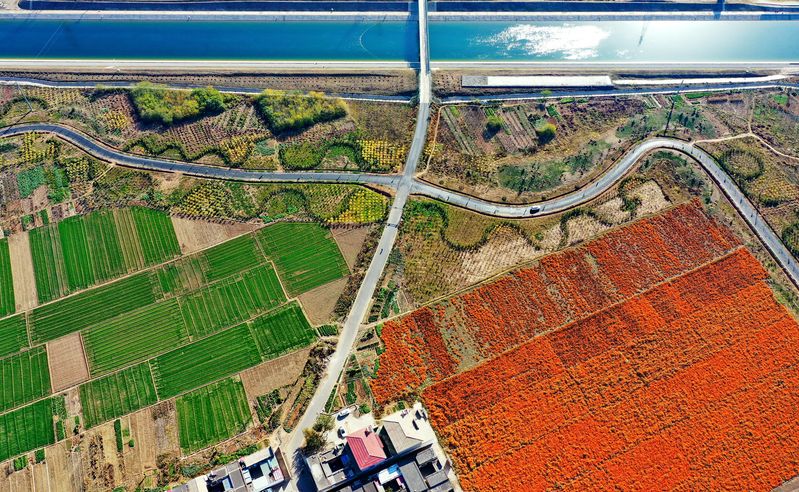
The canal of the south-to-north water diversion project in Handan of north China's Hebei Province, Nov. 14, 2019. (Xinhua/Mu Yu)
In Tianjin, the water supply of residents in 14 districts is all from the diversion project; the Yangtze River also feeds 37 cities and counties in Henan and over 90 cities, counties and districts in Hebei.
BETTER LIFE FOR RELOCATED PEOPLE
The mega water transfer project also brings with it a torrent of doubts and worries on issues such as the relocated residents, water quality and the negative impact on the environment near the Danjiangkou Reservoir, the water source areas of the middle route.
To allow water from Hanjiang River, a major tributary of the Yangtze, to flow to the country's northern regions, the dams of the reservoir were raised to their highest level, which meant a total of 125,000 mu (around 8,333 hectares) of land in Hubei would be submerged including the house of villager Tan Chengping.
As one of 182,000 residents in the city of Shiyan who had to leave their homes, Tan was a staunch opponent of the project then. "No one in my village wanted to leave," he recalled. "We feared nobody would care for us after we were relocated to the new places."
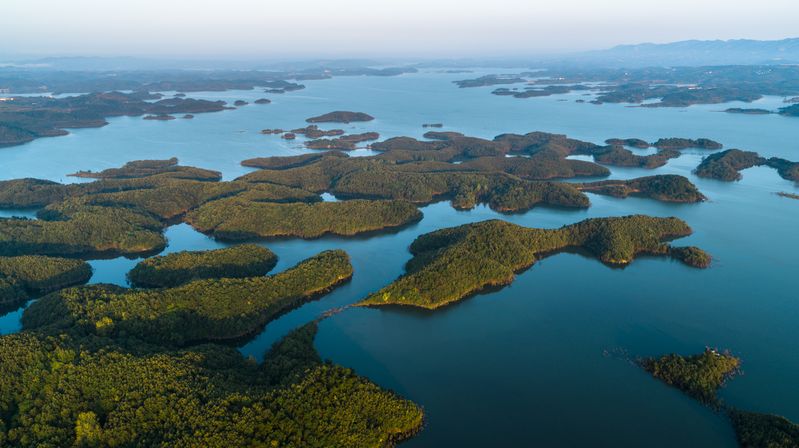
The scenery of Danjiangkou reservoir, Sept. 26, 2019. (Xinhua)
What happened later proved that Tan's worries were unnecessary. Six months after he was told to move in 2011, Tan's family moved to a new 100-square-meter house built by the local government at a higher area about 2 km away from his old house.
Along with the other villagers who moved there, Tan attended a free orange planting training course organized by the government after he was given four mu of new farmland, less than his previous land but more profitable.
"This year, I can harvest 10,000 kilograms of oranges, which is expected to bring me more than 20,000 yuan (around 2,841 U.S. dollars)," Tan said.
Two years ago, Tan and his wife opened a rural family inn to serve tourists visiting the Danjiangkou Reservoir. His family's income has exceeded 100,000 yuan this year.
"We finally bid farewell to the days when what we earned was only enough for food and clothing," he said.
A total of 22,000 people out of all the relocated people in Shiyan lived below the national poverty line before the middle route of the water diversion project started operation in 2014. Up to now, all of them have been lifted out of poverty, according to the city's relocation service center.
PROTECTING WATER SOURCE AREAS
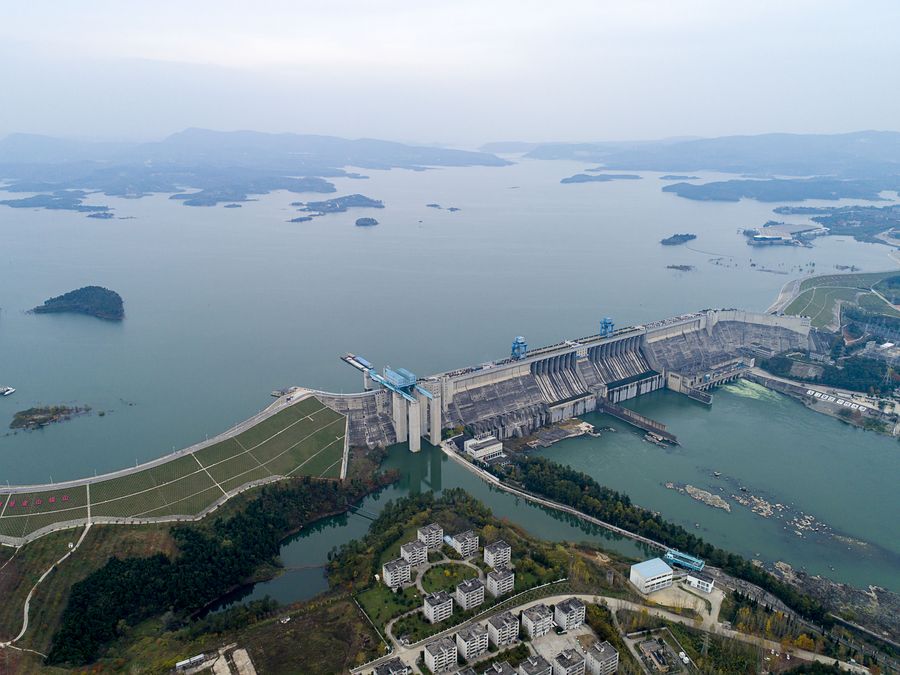
The Danjiangkou reservoir in central China's Hubei Province, Nov. 26, 2019. (Xinhua/Xiong Qi)
To ensure the water quality, China has invested heavily to prevent and treat water pollution and conserve soil in the reservoir and its upper reaches since 2016. Environmental authorities have shut down all factories near the reservoir that could threaten water quality.
Over the past five years, the water quality of Danjiangkou has been kept at the level of Grade II or higher, which means the water is suitable for drinking after filtration.
Nowadays, the Danjiangkou Reservoir has become a paradise for egrets. "Instead of being destroyed by sending water to the north, our ecological environment has benefited from the project," said 35-year-old Zhang Weibin, chief engineer of a local sewage plant.
Experts pointed out China will still face an obvious gap between water supply and demand in the long run as population soars and cities expand.
In the future, the government should continue to ensure the safe operation of the water transfer project, while encouraging residents to use water more effectively, said Ni Guangheng, a water resource professor with Tsinghua University.
(Reporting by Cheng Lu, Wei Mengjia, Wu Zhi, Zou Xuemian and Li Wei; video reporters: Yu Guoqing and Pan Zhiwei; video editor: Liu Ruoshi)■
