WUHAN, Sept. 22 (Xinhua) -- Having spent half his lifetime at Luojingtan ferry dock, Wu Kexi, a former captain, gazed at the Yangtze River and high-rises on the bank in nostalgia.
"This place carries my youth," said the 49-year-old.
Luojingtan ferry dock was shut down on June 28 for the protection of wild animals in the Yangtze, including Chinese sturgeons and finless porpoises.
Wu was born in Aijia, a small town next to the Yangtze River and backed against mountains in the city of Yichang, central China's Hubei Province. Due to its geography, for decades, the only way for locals to leave was to take a ferry.
"In the 1990s, it would take us a whole day to go to the downtown area across the river," Cai Daming recalled. The 71-year-old is seen as the know-it-all of Aijia Township. "We had to get up early to catch the ferry and it was so crowded and exhausting," Cai added.
In 1996, Wu founded the Hailong Transportation Company, operating ferry routes from Aijia to Wuyi Square on the opposite bank of the Yangtze. "My passengers included farmers who headed for Wuyi Square to sell their vegetables, workers who commuted to chemical plants in Aijia, and mothers who were about to give birth to babies in hospitals across the river," said Wu.
At its peak, the five ferries Wu owned transported over 2,000 people each day. The ferry dock was so popular that it was called "the Shanghai of Aijia," but before its closure, the number decreased to around 500 people per day, according to Wu.
Now, the once-bustling ferry hub is blocked by rails and overgrown with weeds.
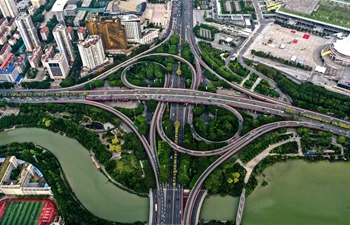
Cai attributed the dwindling flow of passengers to better transportation conditions. In the early 2000s, bridges were built over the Yangtze River in Yichang, therefore, providing residents in the town with an alternative to the ferry.
"Now, we can shuttle several times between the two banks of the Yangtze River within a day," said Cai.
The transformation of the local industry has also resulted in the slack ferry business, as workers no longer commute to the town.
Yichang, the city where Aijia Township locates, is rich in phosphorus, water and shipping resources. The chemical industry was once the backbone industry of Aijia.
Hundreds of meters away from Luojingtan ferry dock stands the Tiantian Chemical Plant. The factory had been flourishing since the 1970s, paying hundreds of millions yuan of taxes every year and attracting plenty of migrant workers.
However, Tiantian Chemical Plant brought about pollution to the environment. "Back then, black dust filled the air. Those who lived near the plant dared not open windows. And the oranges we grew, covered by dust, were refused by consumers," said Wang Qinghua, a former worker at the Tiantian Chemical Plant.
The turning point of Aijia's environment came as pollution control campaigns on the Yangtze River proceeded. In 2017, Yichang municipal government rolled out a series of reforms against chemical industries to shut down unqualified plants and to impel those plants which may pose risks to the environment to transform into eco-friendly ones.
The practice of reform in Yichang started from the Tiantian Chemical Plant. Two years after its closure, all its plants have been removed, and the polluted soil has been restored.
According to Yichang government, in 2018, the number of good air days totaled 274, hitting a record high within past five years; the concentration of phosphorus in the Yangtze River keeps declining, and the water quality maintained Grade II, the second-highest ranking in China's five-grade standard.
"Though I lost my job, I think it's worthwhile that my daughter can grow up in a town with a blue sky and fresh air," Wang added.
Wei Hai, the Party chief of Aijia Township, said workers left the town as the closure and moving out of the chemical plants. Meanwhile, more tourists come to the town to experience rural life.
As the environment improves, some residents of Aijia open restaurants for visitors and some run online shops to sell fruit and local specialties. According to the city planning committee of Yichang, Aijia will focus on culture and tourism as well as innovative technology industries in the future.
Around 2 km downstream from the abandoned Luojingtan ferry dock, a modern bridge over the Yangtze is under construction and will be put into operation by the end of 2020.
"When it is open to traffic, travel time from Aijia to the opposite bank will be cut in half, and we will have more opportunities to make a better living," said Wang.