



The Ethnic Games is more than just a sporting gala, it provides a platform for China's rich multi-ethnic culture.
by Xinhua writers Gu Lilin, Sun Zhe
ZHENGZHOU, Sept. 15 (Xinhua) -- 81-year-old Hu Anmin used to perform Chinese rope skipping alone at China's Ethnic Games, but not anymore.
He has inspired more than 100,000 ordinary people from around China to join in the sport which may have been the retired teacher's proudest achievement since he made his debut at the Ethnic Games two decades ago.
Creating opportunities for ordinary people at different ages who have sports dreams, is what Ethnic Games values.
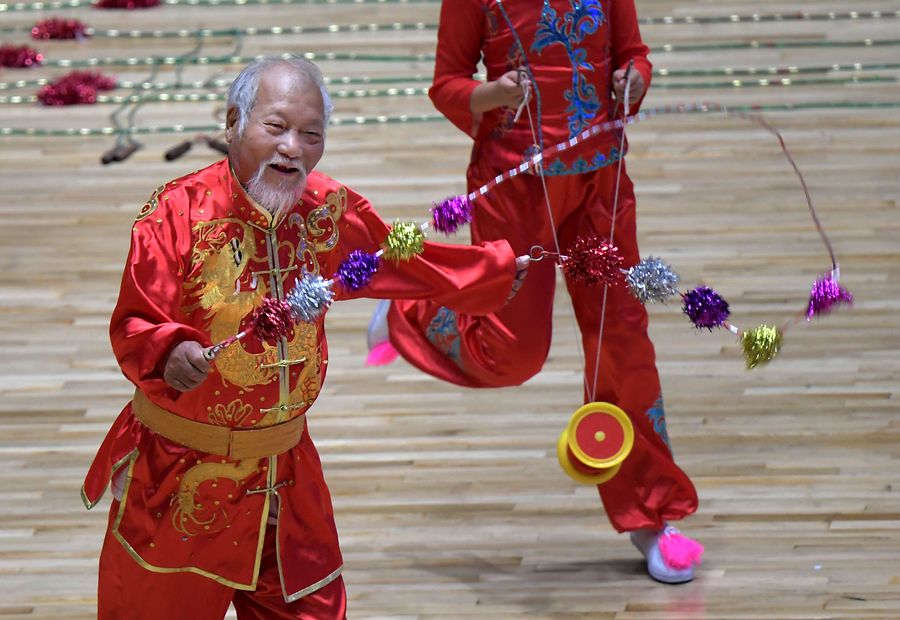
Hu Anmin performs rope skipping at the 11th National Traditional Games of Ethnic Minorities of the People's Republic of China, on Sept. 14, 2019. (Xinhua/Li An)
THE KING OF THE ROPE
If you strip away his prestige that comes with being known as the King of Chinese rope skipping, Hu from the Man ethnic group is just like an ordinary elderly man with grey hair and beard. However, browsing his photo albums, you can see he has lived a life that is deeply fulfilling.
He's the connector of dots, like a bridge that brings ordinary people to an event which has a long history. He collected, inherited and also created about 300 styles across 12 categories of rope skipping that have a long history in his ethnic group.
"I love being here because it's something that I've never experienced before," Hu, one of the oldest athletes in the 11th Ethnic Games, said. "I love all of the dreams I have fulfilled and still am chasing at the Ethnic Games."
This year's gala saw Hu's family members also participate as rope skipping performers, including his son, daughter and 10-year-old granddaughter.
"I'm very optimistic that I can perform in the Ethnic Games four years from now, while my second grandson will be over five years old and can also join," Hu added.
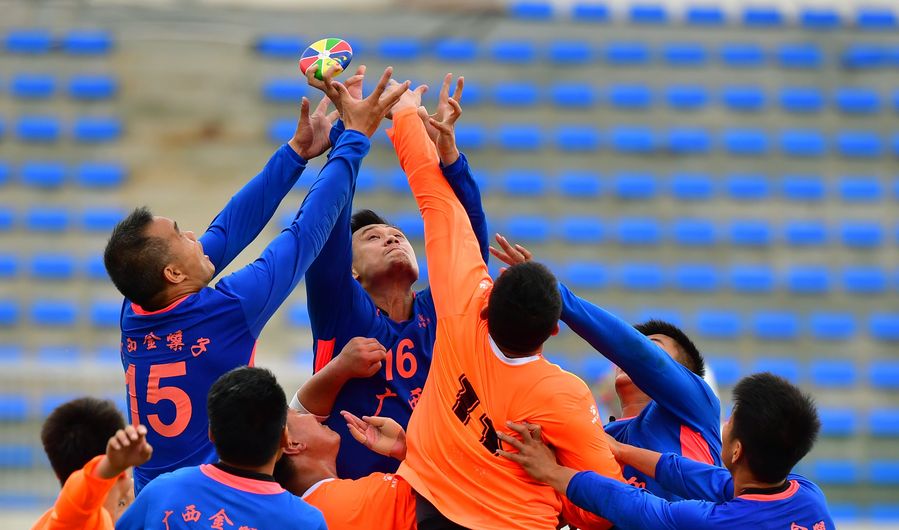
Players compete during the sparkler-grabbing game between Guangxi and Ningxia at the 11th National Traditional Games of Ethnic Minorities of the People's Republic of China in Zhengzhou, central China's Henan Province, Sept. 13, 2019. (Xinhua/Huang Xiaobang)
"CHINESE RUGBY" MAKES A SPARK
In terms of popularity, "sparkler-grabbing" reigns supreme for the Zhuang, Dong and other ethnic groups in China's Guangxi Zhuang Autonomous Region, and it is no different for Tan Yimou from the Zhuang ethnic group.
As with many of his fellows, Tan has sweated every day to practice since he was only 12. The sport is known as "Chinese Rugby". Apart from the colourful disk about the size of a man's hand used in the sport instead of a ball, there are similarities between the game and rugby.
"Sparkler-grabbing made its debut as an exhibition event in China's 2nd Ethnic Games in 1982. Four years later in Hohhot, it was listed as an official event when I first represented Guangxi as a player," Tan recalled.
At that time, sparkler-grabbing was still foreign to most people from other parts of China, or it was just seen as a peculiar ethnic event that was held during local festivals.
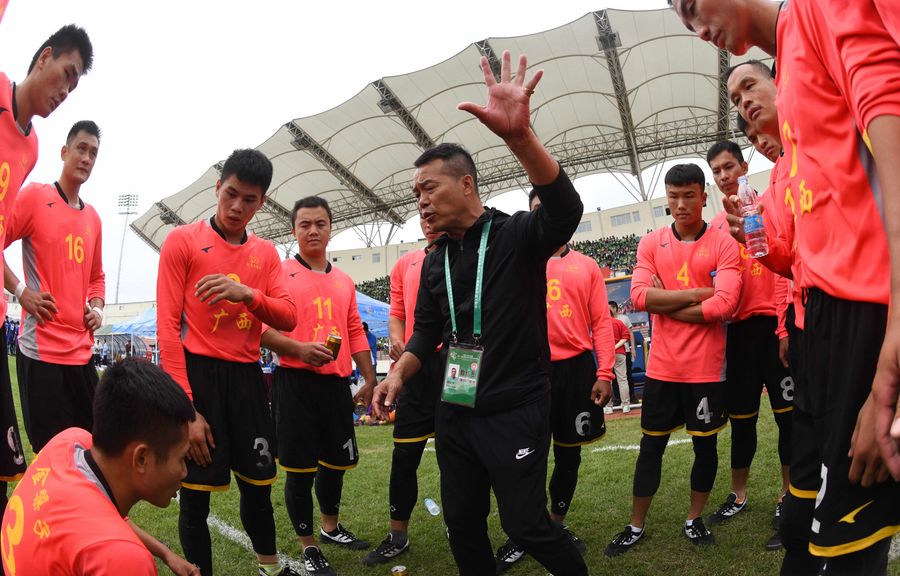
Tan Yimou (front, C), coach of Team Guangxi, gives instructions before a sparkler-grabbing game at the 11th National Traditional Games of Ethnic Minorities of the People's Republic of China in Zhengzhou, central China's Henan Province, Sept. 14, 2019. (Xinhua/Huang Xiaobang)
Tan and other enthusiasts played major roles in promoting the event to get nationwide recognition.
"It's helpful to popularize sparkler-grabbing through standardizing rules and taking it closer to modern sports so that more people can participate," Tan said.
Tan's efforts paid off and at this year's Games, Guangxi team only scraped to win the title over the rising Beijing team.
After the Chinese government issued an action plan for 2019-2030 to implement the country's Healthy China initiative and promote people's health, Tan was happy to see that traditional sports including sparkler-grabbing make their way into the school curriculum in Guangxi.
Tan is still having fun in the event and has become Guangxi head coach at the ongoing 11th Ethnic Games.
"It's part of who I am, promoting sparkler-grabbing is more important than anything else," he said.
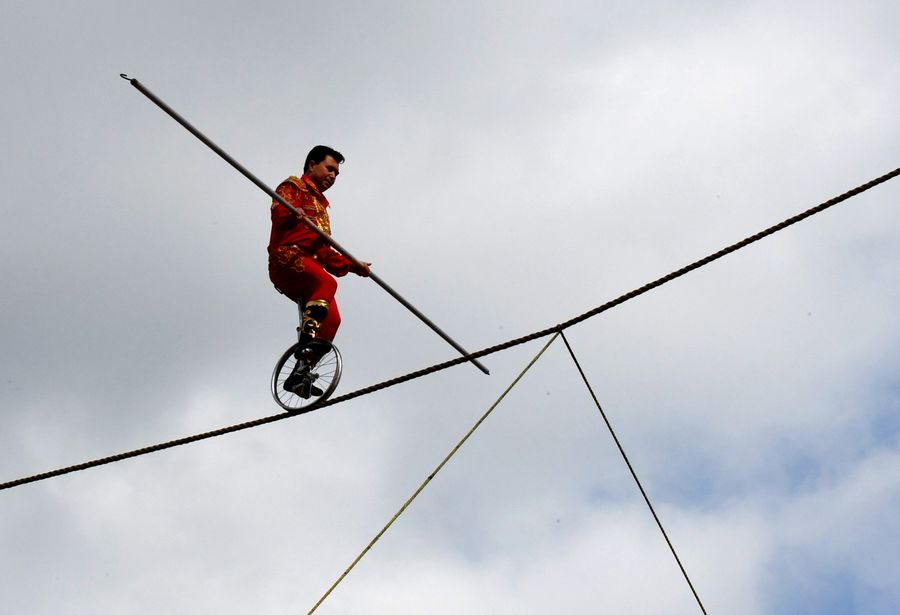
Adil Uxur performs Dawaz at the 11th National Traditional Games of Ethnic Minorities of the People's Republic of China in Zhengzhou, central China's Henan Province, Sept. 13, 2019. (Xinhua/Zhu Xiang)
A MULTI-ETHNIC FABRIC
Cheered on by crowded spectators, high-wire walker Adili Wuxor performs the Uygur ethnic group's acrobatic feat known as Dawaz with his pupils on a tightrope high above the ground.
Standing out as one of the most recognizable figures, 48-year-old Adili is competing at his 10th Ethnic Games since 1982. Conserving and popularizing the cultural heritage of this quadrennial event has become a duty for him.
"Thanks to the inaugural ethnic games held in 1953, my father brought Dawaz to a larger stage, even though the sport was once on the verge of extinction," Adili recalled, whose ancestors have lived in the obscure county of Yengisar near the Taklimakan Desert for generations.
Following in his father's footsteps, the sixth generation of Dawaz practitioners press on, even going barefoot in winter because there was not enough money to buy a pair of training shoes. But the sport made quite a splash when he brought Dawaz to China's 2nd Ethnic Games in 1982.
"The Ethnic Games is more than just a sporting gala, it provides a platform for China's rich multi-ethnic culture," Adili said.
His hard work has paid off. Dawaz was selected among the first batch of China's "Representative List of Intangible Cultural Heritage" in 2006. "It seems like a dream comes true when Dawaz reached this unprecedented level," Adili described.
A specialized acrobatics school for Dawaz also has been established in Yengisar to train talented youngsters.
"It will continue to grow, and I really enjoy passing on the delights of Dawaz to pupils of all ages," Adili said.
He has already set his sights further ahead: to get this unique creation onto the World Intangible Cultural Heritage list. "It's good to see this national treasure flourishing again. I will keep trying until I make it," Adili concluded. Enditem (Niu Shaojie, Li Wenzhe, Lu Xianting and Liu Huaipi also contribute to the story)■
