



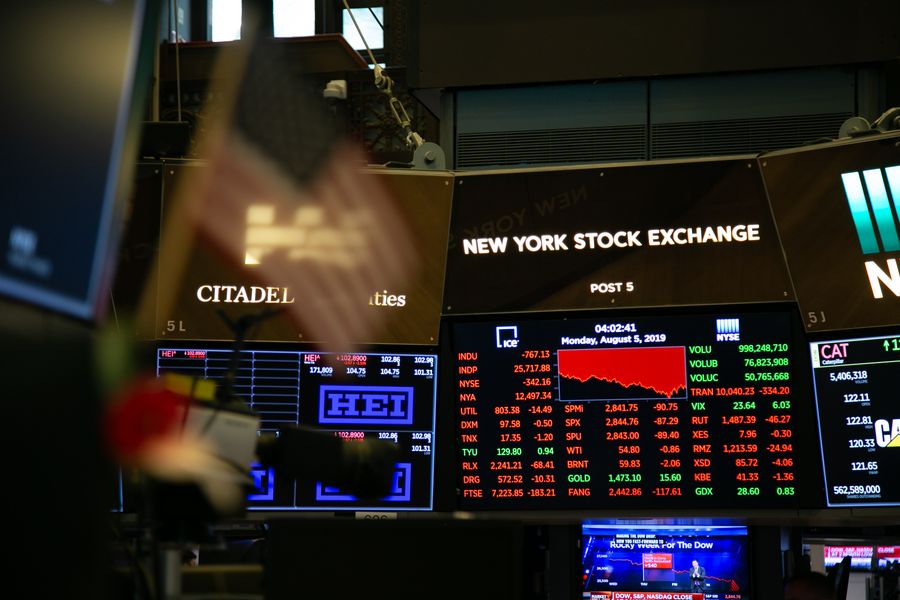
Trading chart is seen on an electronic screen at the New York Stock Exchange in New York, the United States, on Aug. 5, 2019. U.S. stocks plunged as investors worry that U.S. President Donald Trump's threatened new tariffs on Chinese imports will worsen trade prospects. (Xinhua/Guo Peiran)
In a blog post titled "Taming the Currency Hype," IMF experts said that imposing tariffs is a counterproductive policy to tackle currency overvaluation because "tariffs and exchange rates work differently."
WASHINGTON, Aug. 21 (Xinhua) -- The International Monetary Fund (IMF) warned Wednesday that American importers and consumers are footing the bill for the U.S. administration's tariffs imposed on Chinese goods, and that the levies won't resolve the trade imbalance between the two economies.
In a blog post titled "Taming the Currency Hype," co-authors Gustavo Adler, Luis Cubeddu and Gita Gopinath argued that imposing tariffs is a counterproductive policy to tackle currency overvaluation because "tariffs and exchange rates work differently."
Gustavo Adler currently serves as the deputy division chief at the IMF's research department, Luis Cubeddu as the head of the open economic division at the department, and Gita Gopinath as the IMF chief economist.
"A 10 percent tariff does not necessarily offset a 10 percent more appreciated (overvalued) exchange rate," they said.
The IMF researchers said average U.S. tariff on goods imported from China has increased by about 10 percent since early 2018, and it would increase by another 5 percentage points if recently announced plans to impose additional levies are carried out.
U.S. President Donald Trump announced on Twitter on Aug. 1 that the United States will impose an additional 10 percent tariff on some 300 billion U.S. dollars worth of Chinese imports, effective from Sept. 1.
The Office of the U.S. Trade Representative said in a statement on Aug. 13 that some of those tariffs will be delayed to Dec. 15.
The depreciation of China's currency, the renminbi, is largely "a result of these trade actions and associated uncertainties," the economists said.
"U.S. importers and consumers are bearing the burden of the tariffs," read the article. "The reason: the stronger U.S. currency has had a minimal impact thus far on the dollar prices Chinese exporters receive because of dollar invoicing."
"Higher bilateral tariffs are unlikely to reduce aggregate trade imbalances, as they mainly divert trade to other countries," the authors said.
"Instead, they are likely to harm both domestic and global growth by sapping business confidence and investment and disrupting global supply chains, while raising costs for producers and consumers," they added.
Trump has repeatedly lashed out at the Federal Reserve (Fed), scolding it for not having cut the benchmark interest rate enough, while expressing the frustration that a strong dollar leaves the U.S. economy in a disadvantageous position vis-a-vis other economies in the world.
"The only problem we have is (Fed Chairman) Jay Powell and the Fed ... We are competing with many countries that have a far lower interest rate, and we should be lower than them," Trump tweeted Wednesday. He also claimed that Tuesday marked the "highest Dollar in U.S. History."
The IMF blog post pointed out that "one should not put too much stock in the view that easing monetary policy can weaken a country's currency enough to bring a lasting improvement in its trade balance."
Countries that run trade deficits such as the United States, the economists said, "should reduce budget deficits without sacrificing growth and strengthen the competitiveness of their export industries."
