




BEIJING, July 21 (Xinhua) -- With all the twists, turns and countermarches along the 12,500-km-long journey, the soul-stirring stories of the legendary Long March starting in 1934 have taken on a new lease of life 85 years on.
The epochal, varicolored expedition undertaken by the Red Army captured the imaginations of not only the Chinese but also the foreigners who marveled at the victories at countless battles within a hair's breadth of defeat and the triumph of the human spirit.
Their experience was recorded on the pages of the 1936 book "The Restraining Hand" by R.A. Bosshardt, a British missionary who spent 560 days with the Red Army, and Edgar Snow's "Red Star Over China" published one year later after days of conversations with Chairman Mao in his cave-house in the loess hills of northern Shaanxi.
Last month, hundreds of journalists from dozens of media outlets across China hit the road to follow in the footsteps of the Red Army, inspiring the whole nation to join the Long March of the new era with their pictures and stories.
The major ongoing event has enjoyed extensive press coverage, jogging people's memories of the great human epic and spurring them to strive for the realization of the "two centenary goals" and the Chinese Dream of national rejuvenation.
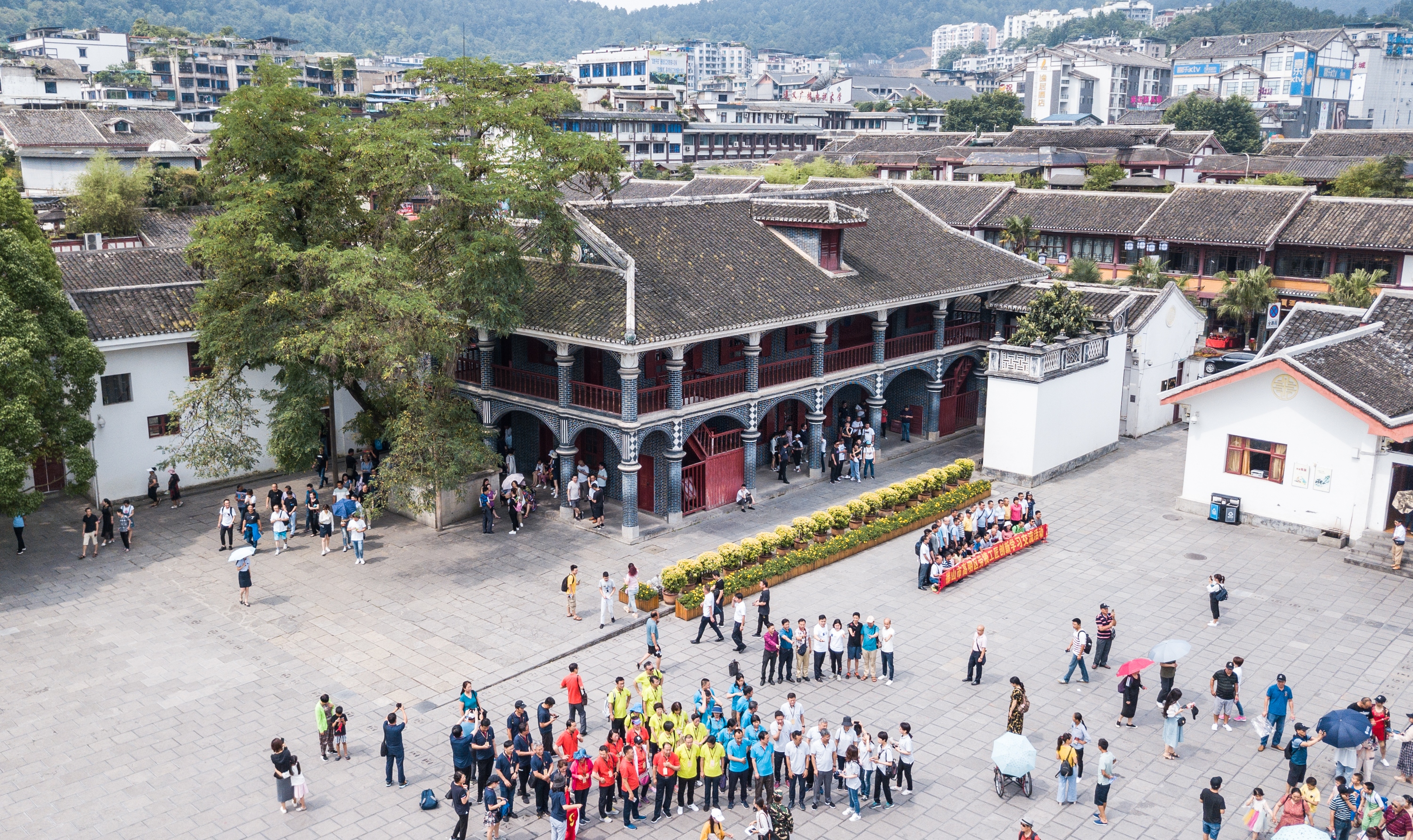
Aerial photo taken on July 4, 2019 shows people visiting the site of the Zunyi Conference in Zunyi City, southwest China's Guizhou Province. (Xinhua/Tao Liang)
SACRIFICES MADE MINDS STRONGER
"More minds grow stronger for the martyrs' sacrifice, daring to move the sun and the moon to new skies. Happy I see now wave upon wave of corn and rice, here and there heroes come home at dusk as smokes rise."
Thirty-two years after Mao Zedong left his homeland Shaoshan in central China's Hunan Province in 1927, he wrote this seven-character verse to express his feelings about the changes to the place of his early revolutionary years and the spiritual strength of the people who had made sacrifices for the Chinese revolution.
And the Long March remains just about the irreplaceable and unequaled odyssey in modern Chinese history.
On the battlefield ruins along the Xiangjiang River, a major tributary of the Yangtze, old trenches loom among the trees. Graves of the Red Army soldiers can be found everywhere -- some are tall, some are just heaps of earth; some are buried with bones, some are cenotaphs; some are engraved with heroic names, but many more are anonymous.
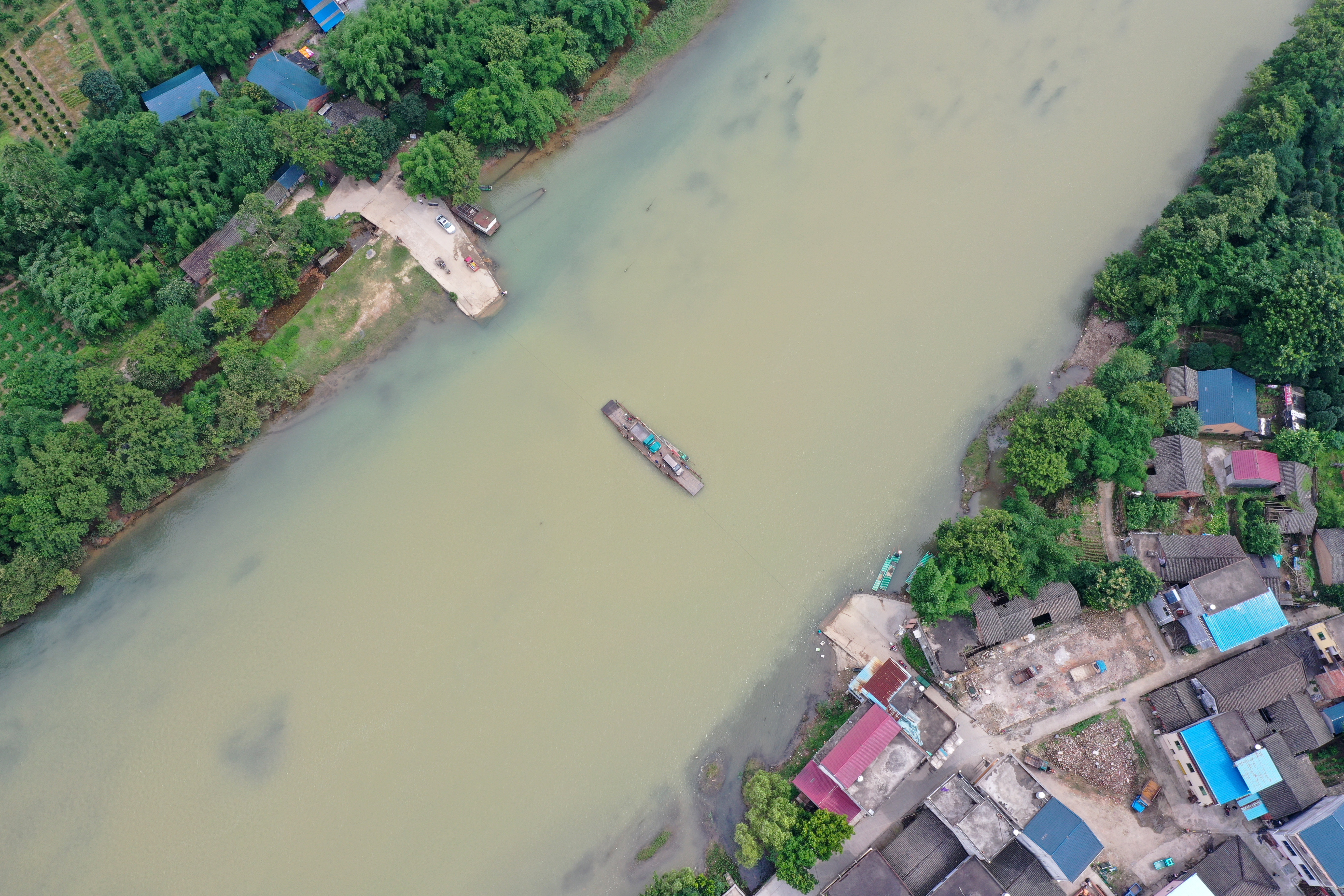
Aerial photo taken on June 29, 2019 shows the Fenghuangzui ferry in Fenghuang Town, Quanzhou County of south China's Guangxi Zhuang Autonomous Region. (Xinhua/Lu Boan)
The Battle of Xiangjiang River was a fierce battle in which the Central Red Army suffered heavy casualties since they started the year-long trek to escape from the encirclement of Chiang Kai-shek.
The number of Central Red Army soldiers, aged under 20 on average, fell to just over 30,000 after the battle from some 86,000 when they set off to leave their bases in east China in mid-Oct. 1934.
To cover the main forces as they crossed the river, 29-year-old commander Chen Shuxiang led his 34th Division of the Fifth Army Corps to fight a rearguard campaign against the pursuing Kuomintang (KMT) troops.
After fighting off wave after wave of relentless attacks and resorting to guerilla warfare in the mountains, Chen, being shot in the abdomen, was captured by the enemy. He did not surrender and tore his bowels to die a heroic death.
"Chen's sacrifice reflects high loyalty, belief, responsibility and bravery, " said Jiang Yuanshen, an expert from Hunan who specializes in the history of the Communist Party of China (CPC).
The Red Army fought more than 660 battles throughout the Long March. On average, for every kilometer of the march, three or four soldiers sacrificed their lives.
"Sacrifices lie in the core of their persistent pursuit of ideals, beliefs and great ambitions to save the nation and fight for the emancipation of the laboring masses," Jiang said.
TIGHTLY BONDED AS FISH AND WATER
The history of the Long March is one that reflects the inseparable relationship between the army and the people.
"Those men and women did everything for the people, by the people, and valued the people's interests most of all. It was what drove them to go forward without fear of sacrifice," said Hu Qunsong, a Long March history researcher.
Shangshaozhai Village in southwest China's Guizhou Province was once separated from the outside world by a raging river for hundreds of years before the Red Army passed by and built a wooden bridge together with local villagers in December 1934.
"They brought out all the available timber at home, and many of the villagers even volunteered to provide their bed and door boards," said 68-year-old Wu Xiyan. Wu's uncle was among the villagers who worked with the soldiers in building the "Red Army Bridge," a name then given to commemorate the close relations between the Red Army and the people.
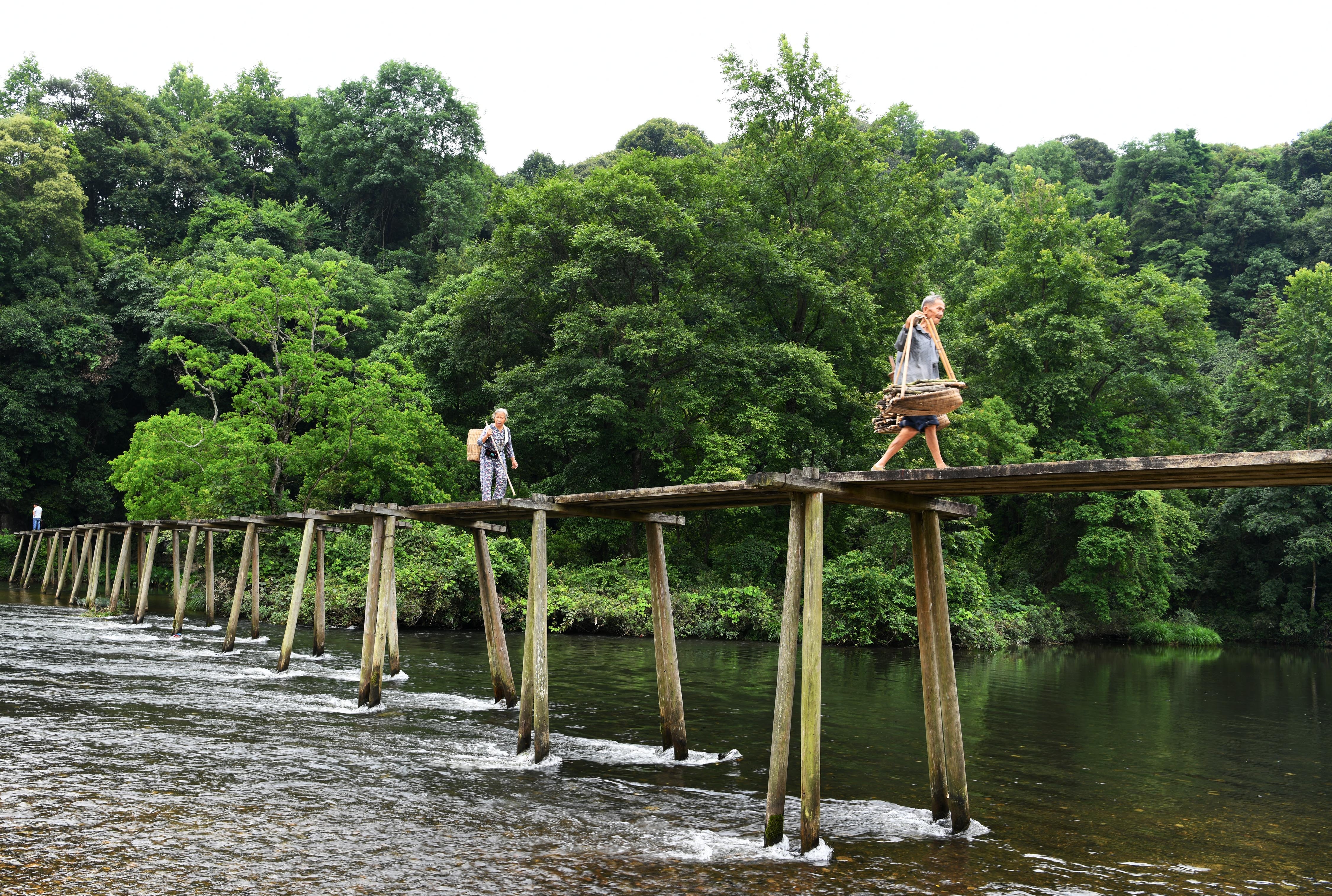
Villagers walk on a Red Army Bridge in Liping County, southwest China's Guizhou Province, July 2, 2019. (Xinhua/Yang Wenbin)
In an ethnic Dong village in Hunan, everyone knows the story of the "Red Army Lantern." It was a gift to Yang Zaineng, a native who showed the way for the Red Army soldiers on a dark winter night of 1934.
The lantern has become an heirloom of the Yang family since then and was passed on to the owner's youngest son Yang Zhengyi who told his own son to join the military and be like the Red Army soldiers.
"When my grandson grows up, I'll tell him the story of the lantern," Yang Zhengyi said.
The Long March, in a sense, was a grand armed publicity tour during which tens of millions of the poor came to understand the CPC's aims of agrarian revolution and their anti-Japanese aggression determination.
Many fell or dropped out both in battles and from the harsh environments, while more of the disinherited joined in -- farmers, workers, serfs and KMT deserters.
LONG MARCH SPIRIT LASTS FOREVER
Today, many of the old battlefields have turned into bases for patriotic education. In Rucheng County of Hunan, a memorial hall has been built to tell people the 1934 story of three young female Red Army soldiers who halved their quilt for a local countrywoman.
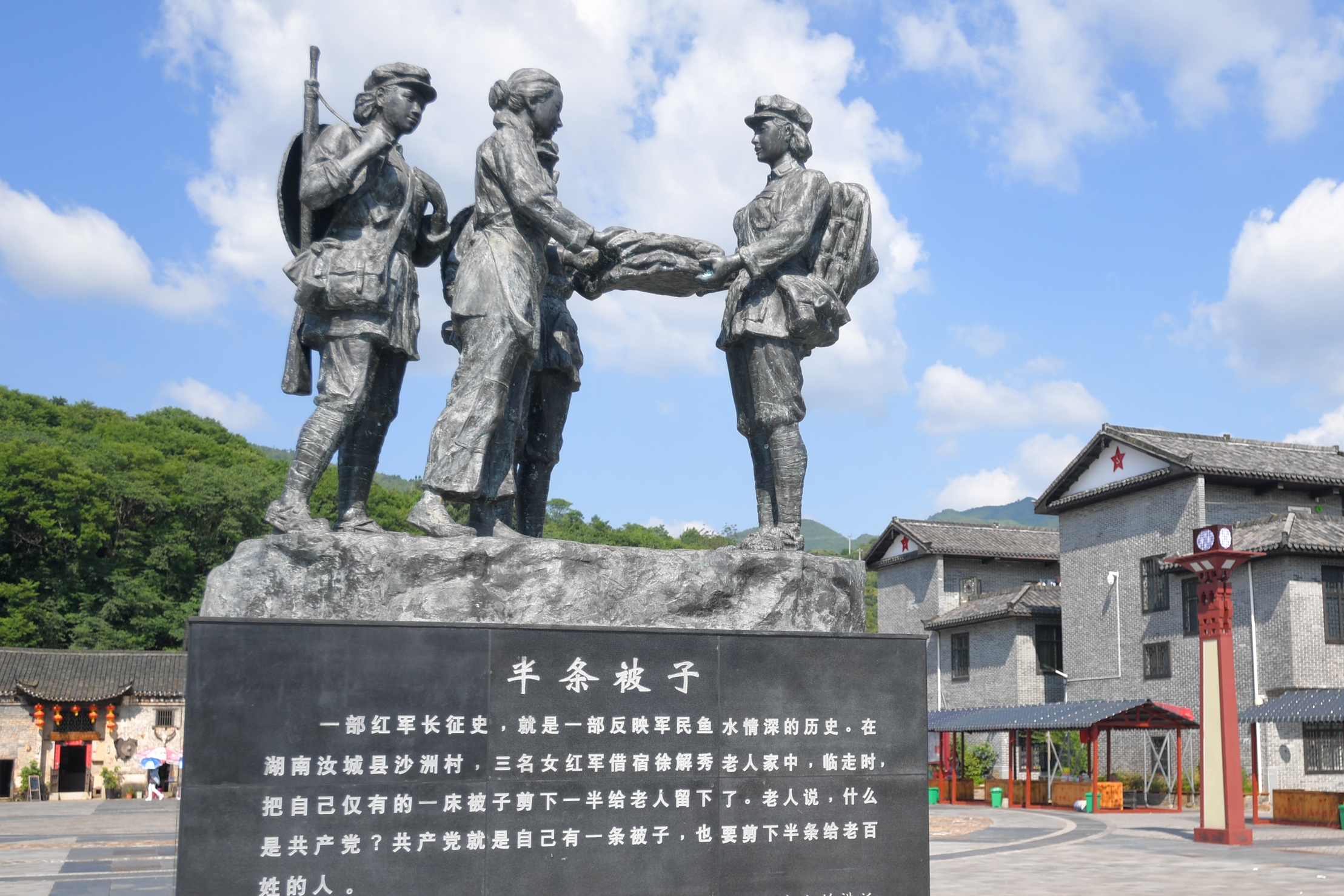
Photo taken on June 14, 2019 shows the sculpture commemorating the story of three female Red Army soldiers who halved their quilt for a local countrywoman in Shazhou Village of Rucheng County, central China's Hunan Province. (Xinhua/Chen Zeguo)
In Guizhou, where the Red Army regrouped and developed through its most trying period, red tourism has been in full swing. Zunyi, a city witnessing a crucial turning point that led to the ultimate success of the Long March, drew more than 40 million visitors in the first 10 months of last year.
"The Long March is sui generis," the Pulitzer Prize-winning journalist Harrison Salisbury wrote in his 1985 book after retracing the route. "Its heroism has fired the dreams of a nation of 1.1 billion people and set China moving toward a destiny no man can yet divine."
It tested the will, courage and strength of the men and women who helped forge the genesis of a new China, and inspires the Chinese people today in chasing their dreams of a brighter future.
"Fear not the strong pass iron-clad on all sides, the summit's now surmounted with great strides," the words Chairman Mao struck off after a big win in 1935 remind the Chinese people of the hard-won victory of the Long March, forever striding on.
"The new long march today, although without snow-topped mountains and grasslands, still calls for our courage to keep going forward in spite of all dangers and difficulties," Hu Qunsong said.
(Video reporters: Cheng Ji'an, Ding Chunyu, Qin Guanghua, Liang Shun, Yang Chi, Kang Wenjun, Liu Qinbing, Chen Qiang, Yang Yanbin, Wu Siyang, Tian Tian; Video editor: Lin Lin)
