




 ?
?
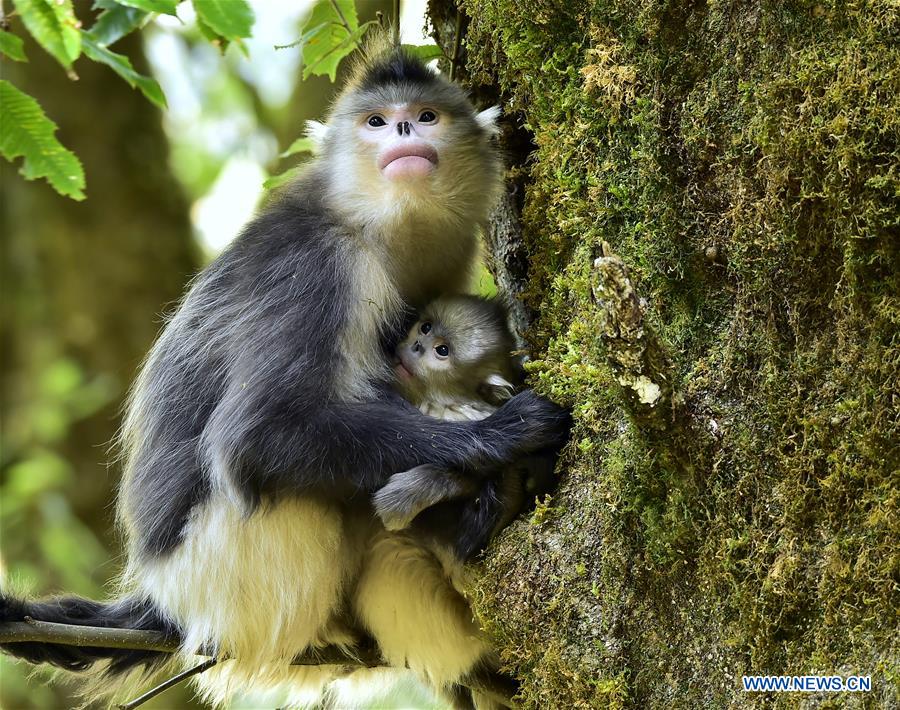
Yunnan golden hair monkeys are seen in Baima Snow Mountain Nature Reserve in Deqen Tibetan Autonomous Prefecture, southwest China's Yunnan Province, March 29, 2015. (Xinhua/Yu Fengqin)
KUNMING, June 7 (Xinhua) -- Yu Jianhua can tell each different emotion in the calls of the black-and-white snub-nosed monkeys, also known as Yunnan golden hair monkeys.
He can also pick each of the 68 monkeys under his care on sight.
"They are my family," says Yu, 67, a monkey ranger for 22 years. "I'm with them every day."
Yu, of the Lisu ethnic group, works deep in the remote mountains of southwest China's Yunnan Province around his home in Xiangguqing village of Weixi County, a nine-hour drive from the provincial capital of Kunming.
LIVING WITH CARE
Yu used to be a hunter. In 1997, the local forestry authority persuaded him to stop hunting and become a ranger.
"My grandfather told me that the Yunnan golden hair monkeys were considered a human ancestor in Lisu's tale," said Yu. "We must protect them."
Yu was paid 180 yuan (about 26 U.S. dollars) a month at first, but now earns around 1,600 yuan (about 232 U.S. dollars).
It's not an easy job for the 40 or so full-time monkey rangers in Weixi County.
They work two shifts, each patrolling the forest for more than 10 hours every day over an altitude ranging from 3,000 to 3,400 meters.
The rangers avoid walking the same route each time in order to protect the vegetation, said Zhong Tai, director of Weixi County nature reserve department.
"Sometimes our rangers need to stay overnight in the forest if the patrol goes past midnight," said Zhong.
The Yunnan golden hair monkeys around Xiangguqing village are among an estimated population of 2,000 in the Baima Snow Mountain Nature Reserve.
Covering 2,816 square kilometers, the reserve is home to 87 species of animals.
One of the world's most endangered primates, the Yunnan golden hair monkey is considered a bellwether species for biodiversity in the high-altitude region.
Local poachers drove them close to extinction in the 1980s, but the number has since risen above 3,000 nationally thanks to the joint efforts of governments, researchers and local villagers.
NATIONAL EFFORT
The monkeys live in the mountainous forests in Yunnan and neighboring Tibet Autonomous Region, with most in the Baima Snow Mountain Nature Reserve, which was established in 1983 and added to the list of national-level nature reserves in 1986.
It was the first target area for scientific research into the species.
Local governments, nature reserve departments and research institutes have been trying to raise awareness of the importance of the monkeys to the local ecology among the local people, and mobilizing them to engage in the protection work.
"Everybody in the community knows the rivers, forests and vegetation here better than any outsider. Though they once made a living by stripping resources from their surrounding environment, nobody really wants to see their homes destroyed," said Zhong Tai.
"We have worked with the community to instruct villagers in preservation and the consequences of poaching, helping them turn from hunters to protectors."
China has strengthened ecological protection in recent years, incorporating it into the general blueprint for national development with the goal of building a "Beautiful China" by 2035.
Nationwide, hundreds of thousands of villagers like Yu now work as rangers to protect the environment.
The government will also create and implement a plan for the ecological restoration of natural space, and establish and improve mechanisms for the restoration and comprehensive management of mountains, forests, lakes and grasslands.
TECHNICAL PROGRESS
The Yunnan golden hair monkeys living around Xiangguqing village are polygamous and form seven families, according to Huang Zhipang, an associate professor at the Institute of Eastern-Himalaya Biodiversity Research of Dali University.
The reserve staff spread the monkeys' natural raw foods, including lichen, peanuts, corn, dried apples and pumpkin seeds, around the forest and closely monitor their health.
The rangers collect the monkeys' droppings once a month. "If more than five types of parasite eggs are found in the droppings, the monkeys will be treated with medicine in fruit or carrots," Zhong said.
The reserve department trains rangers to promote the importance of protecting rare species and to initiate monitoring and field surveys, while scientists identify DNA through feces analysis.
Baima Snow Mountain Nature Reserve has produced a handbook and field survey table with 17 patrol routes and 56 monitoring sites around Xiangguqing village.
Long Yongcheng, chief scientist of the Society of Entrepreneurs and Ecology Southwest Project Center, said infrared cameras have been used to monitor the monkeys. He hopes to use more advanced field tracking and monitoring technologies.
Professor Xiao Wen, of the Institute of Eastern-Himalaya Biodiversity Research of Dali University, said the Yunnan golden hair monkey is a flagship species because its movement through the dense forest canopy can expose the floor to sunlight, heat and water, benefiting the whole forest.
Xiao Wen's research team used a 3D map-based interview survey method to monitor the terrain, vegetation and water conditions of the monkeys' habitat.
The researchers set up three observation stations in the reserve to monitor climate factors including air temperature, rainfall, and soil temperature, as well as biological groups of plants, aquatic organisms, insects, amphibians, reptiles, birds and other animals, said Huang Zhipang.
They plan to build a field monitoring network for biodiversity protection in other regions.
(Video reporters: Zhang Dongqiang, Li Huaiyan, Yan Yong; Video editors: Shan Ruchao, Ni Hanlin)
