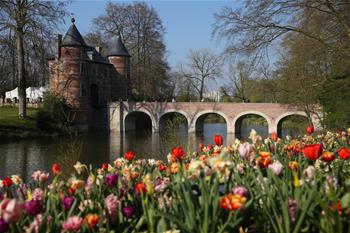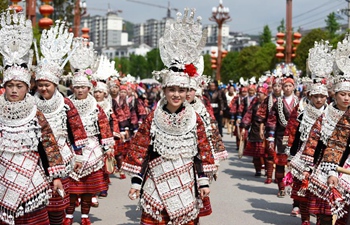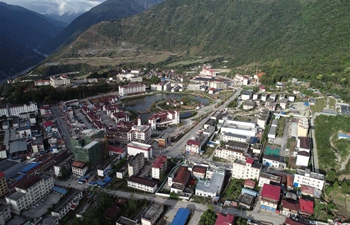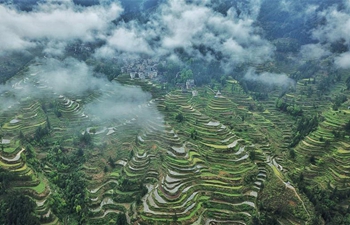

Residents attend a spring plowing ceremony in Shannan, southwest China's Tibet Autonomous Region, March 16, 2019. Since 2004, China has invested more than 3 billion yuan into Tibet. That was directed at more than 450 projects in 10 categories related to agriculture and animal husbandry unique to the region, such as highland barley, yak-breeding and traditional Tibetan medicine. (Xinhua/Purbu Zhaxi)
LHASA, April 19 (Xinhua) -- Hearing from his mother that the first plowing day had been set, Dainzin Losang left Lhasa for his home village, just like he did every year. This year, however, was special.
When rivers thaw and willows turn green in southwest China's Tibet Autonomous Region, Tibetans, dressing in traditional wear, hold a ceremony to mark the beginning of spring plowing.
The exact date varies each year, but this year, it fell on Losang's birthday. So the 26-year-old painter was the first person to till, a move believed to guarantee a good harvest.
On the morning of this special day, Losang, wearing traditional costume, was set to become the village's best farmer.
Leading two decorated yaks, Losang headed into the farmland while a veteran farmer controlled the plow and a young woman planted seeds.
That, however, is the traditional farming method. Huge tractors roared into the field to finish the job.
The village, located about 20 km from Lhasa, the regional capital, has been witnessing a revolution in the local farming style over the past decade, and so has the rest of Tibet.
"Machines are now used on most farmlands, while yaks are only needed in ceremonies," said Wangdui, 51, who was elected secretary of the village committee of the Communist Party of China in 2015 and is making efforts to modernize farming life of the village.
"My mother can now finish all her farm work alone," said Losang. Sent away to learn Tibetan architecture painting at the age of 13, Losang has made a name for himself locally. He earns more than 60,000 yuan (about 8,940 U.S. dollars) a year.
Like Losang, villagers are no longer bound to their croplands and now live a diversified life. They work in construction, transport and have even opened factories to process roasted barley flour.
But unlike many villagers who choose to migrate to the cities to earn a better income, 41-year-old Zhaxi Benba has chosen to stay with his crops.
"This is our ancestors' way of life," Benba said.
Located in Shannan Prefecture, his village boasts "the earliest farmland" in Tibet. Legend has it that about 2,100 years ago, grains were planted here to begin the history of farming on "the roof of the world."
Despite his desire to preserve tradition, he has given in to modernization. He now uses a tractor to replace yaks' role in the spring plowing ceremony, just like the majority of villagers. They even decorate their machines with hada (a traditional Tibetan ceremonial scarf).
Benba also rents out his land to a farming company, earning him more than 13,000 yuan in extra money per year.
Along with changing farming lifestyles in the region, crop yields in Tibet have stabilized at just above 1 million tonnes a year. Compared with 2017, the per capita disposable income of Tibet's rural residents grew about 13 percent in 2018.
Since 2004, China has invested more than 3 billion yuan into Tibet. That was directed at more than 450 projects in 10 categories related to agriculture and animal husbandry unique to the region, such as highland barley, yak-breeding and traditional Tibetan medicine.
Last year, 180,000 people in Tibet were lifted out of poverty. The regional government vows to lift the remaining 150,000 people out of poverty and eradicate absolute poverty this year, when Tibet marks the 60th anniversary of democratic reforms in the region.