




SHANGHAI, Feb. 27 (Xinhua) -- Soon, garbage sorting will no longer be an option but a requirement in China.
Over 300 Chinese cities at or above the prefecture level will start household garbage sorting in 2019, according to an announcement by the Ministry of Housing and Urban-Rural Development last week.
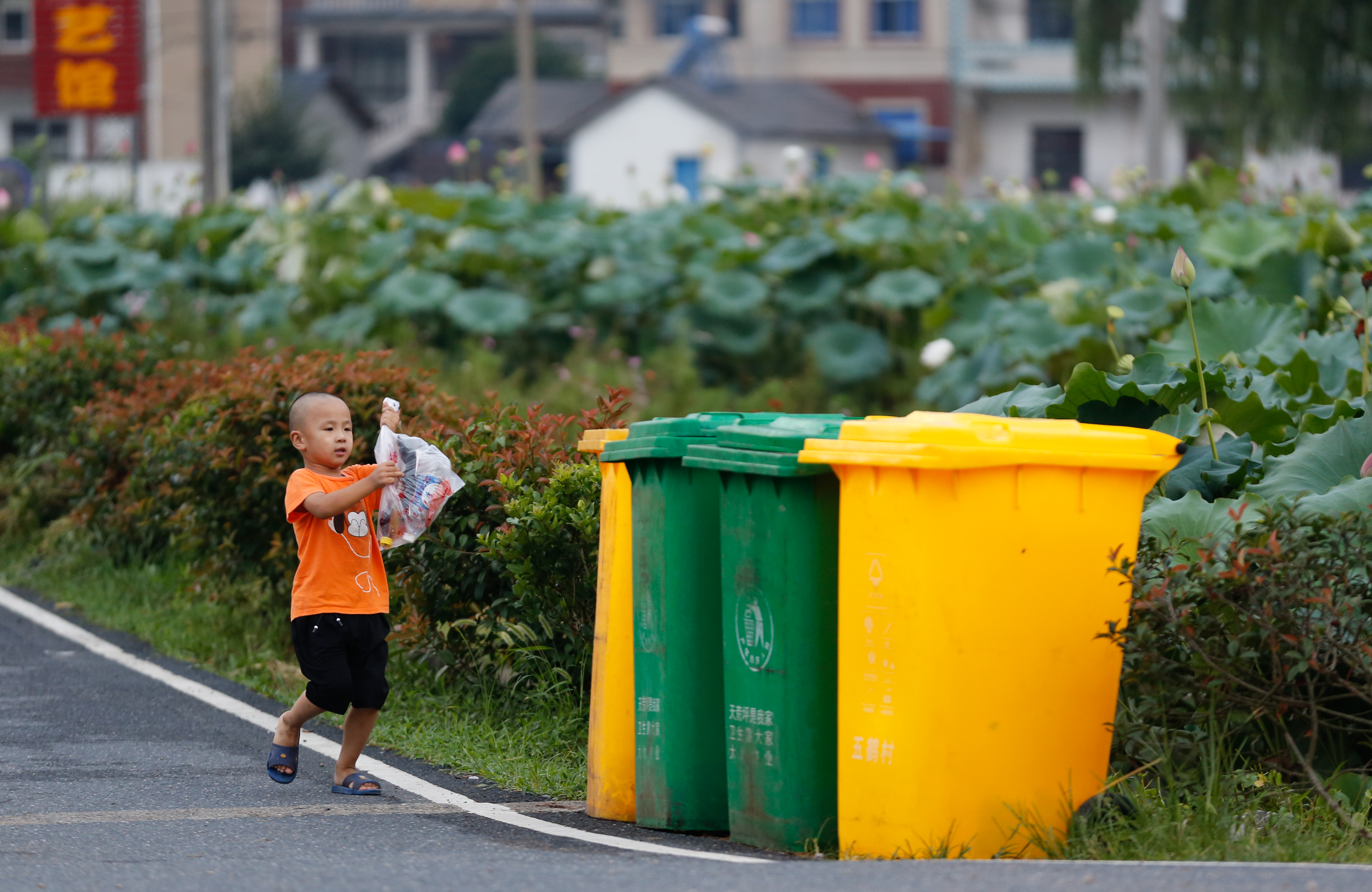
A child dumps waste in Gangkou Village of Anji County, east China's Zhejiang Province, Aug. 16, 2018. (Xinhua/Zhang Chen)
By the end of 2020, garbage sorting systems will be built up in 46 major cities in the country. As one of the 46 cities and a pioneer to implement garbage sorting, Shanghai has experimented with many new methods to encourage a greener lifestyle.
Jiang Maifang, 77, recently started a new job. Living in a residential community in Jiading District of Shanghai, she signed up to be a volunteer at a waste collection point as soon as her neighborhood began implementing the garbage sorting system last October.
When it comes to tips for sorting garbage, Jiang is full of them.
"You should separate things that rot easily from the those that do not and sort out recyclables. Pots are good containers to store kitchen waste," Jiang always likes to share her experiences with neighbors.
"Even though I am older, I am still proud to do something for the good of the younger generations," said Jiang.
The neighborhood Jiang lives in has set up two waste collection points in place of the 26 garbage bins that used to be scattered across the community as well as a fixed schedule for dumping waste, which was previously deemed the hardest way to promote garbage sorting due to the inconvenience it may bring to residents.
With the prevalence of smartphones, many cities in China, including Shanghai, have established a "green account" system. Each time a resident dumps garbage in compliance with regulations, they will collect a certain amount of "green points," which can be later used to exchange for living goods. The incentive system improved participation prominently, yet some residents still refuse to take part.
Yao Lili, a retired Math teacher who lives in the same neighborhood as Jiang, recalled that some neighbors leave their garbage unsorted because it is more convenient.
As a leader of the residential building, Yao tends to subtly arouse people's garbage sorting consciousness.

A sanitation worker collects garbage in Shangdong Village of Lin'an District in Hangzhou, east China's Zhejiang Province, Aug. 16, 2018. (Xinhua/Zhang Chen)
"Whenever I see the garbage bags downstairs, I roll up my sleeves and sort the garbage for them. Seeing this, people who leave their garbage will feel bad and vow to sort it themselves in the future," said Yao. "People may develop the habit of garbage sorting gradually."
Shanghai is resolute to reform the urban environment by establishing municipal solid waste management systems. The public has realized that the reform is imperative.
With a permanent population of over 24 million and a floating one of about 5 to 6 million, Shanghai needs to dispose of up to 26,000 tonnes of garbage per day.
Last Tuesday, Shanghai published a set of regulations on household garbage sorting and recycling and announced that the regulations will be implemented as of July 1 this year.
The regulations have banned the use of disposable cups by Shanghai's Party and government organizations, disposable daily products provided by hotels and disposable cutlery from restaurants and food delivery services unless they are requested by customers.
Hotels and restaurants that fail to observe the regulations can be fined 500 yuan (74.7 U.S. dollars) to 5,000 yuan. Residents who fail to sort the garbage can be fined 50 to 200 yuan.
"Garbage sorting management is relevant to people changing their habits, and it will be a long-term process. Some countries have worked decades or even longer on this endeavor," said Xiao Guiyu, deputy director of the Standing Committee of the Shanghai Municipal People's Congress. "It is a necessity to roll out regulations to promote garbage sorting among citizens."
Li Chao, head of the Landscaping and City Appearance Administrative Bureau of Jiading District, said that a mature disposal system is a prompt for residents to sort their garbage according to the categories.
After the regulations go into effect on July 1 in Shanghai, Jiading will be under two-way supervision by both the government and residents.

A sanitation worker pulls garbage cans at a community in Wuhe Village of Anji County, east China's Zhejiang Province, Aug. 16, 2018. (Xinhua/Zhang Chen)
"The government will supervise individuals' responsibilities of sorting garbage. On the other hand, residents are welcomed to supervise our work," said Li. "We have color-coded every garbage bin and garbage carrying vehicle by category in our district to help people sort the garbage."
Last year, a village and a community in Jiading tried the new garbage sorting system, which required fixed dumping spots and schedule. During the spot check at the end of the year, the purity of wet waste in Jiading had reached over 97 percent. At the beginning of this Lunar New Year, garbage sorting has been expanded to over 280 neighborhoods in Jiading District.
Wang Menghui, minister of housing and urban-rural development, said the promotion of garbage sorting still faces problems in China, such as further improving people's awareness and addressing technical problems in some cities that impede garbage sorting.
To change people's minds, the city government still has a long way to go. So far, 46 major cities have launched over 43,000 garbage-sorting themed lectures and activities, reaching out to more than 12,000,000 with door-to-door education. They have hired over 700,000 volunteers. Twenty-seven of them have introduced garbage sorting education into schools. Thirty-three cities have published and handed out garbage sorting textbooks and brochures.
Reading materials catering to children entered kindergartens, primary schools and middle schools in Shanghai on the first day of the new semester this year to help them develop the habit of garbage sorting at a young age.
It is expected that when old citizens in the city hesitate on how to classify a piece of garbage, the grandchildren can be their teachers. Enditem
