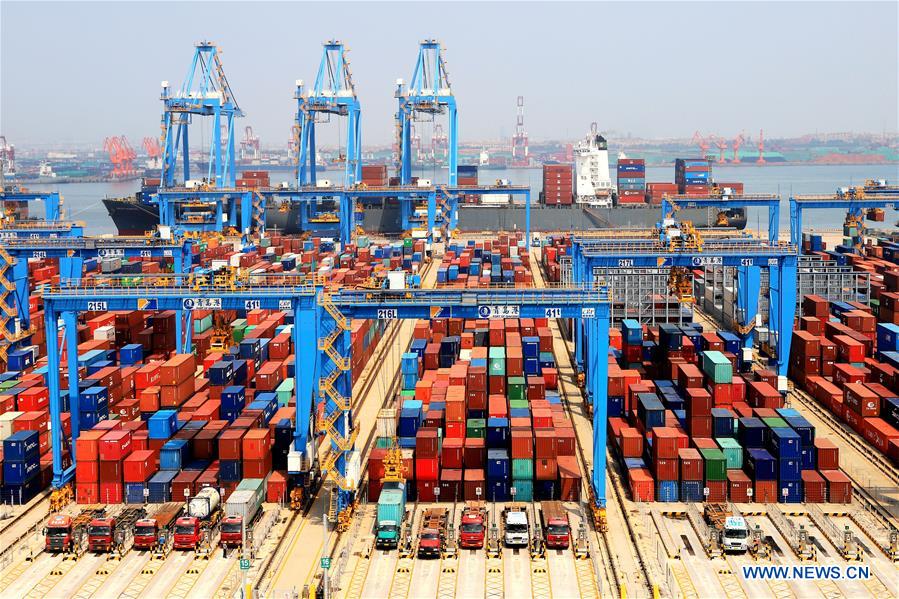
Photo taken on May 16, 2018 shows an automatic container dock in Qingdao, east China's Shandong Province. China's foreign trade rose 9.7 percent year on year to a historic high of 30.51 trillion yuan (about 4.5 trillion U.S. dollars) in 2018, the General Administration of Customs (GAC) said Monday. The value was 2.7 trillion yuan higher than that of 2017, according to the GAC. (Xinhua file photo/Wang Peike)
BEIJING, Feb. 3 (Xinhua) -- As China posted slower growth last year, many are worried that continued downward pressure on the world's second-largest economy could drag global growth. However, a closer look at the economy would prove that the concerns over a slowdown spillover are overstated.
A more sustainable growth model, coupled with a policy package to stimulate growth, will underpin the economy in 2019, bringing abundant opportunities to global investors who stay prepared to cash in on the ever-evolving market.
Here are four reasons to remain upbeat about the Chinese economy.
MORE SUSTAINABLE GROWTH
While the 6.6-percent GDP growth rate that China registered last year was slower than that in 2017 and the double-digit growth was often seen in the past decades, investors should not overlook the fact that the growth was based on a much larger economic scale, analysts said.
The Chinese economy expanded to over 90 trillion yuan (about 13.4 trillion U.S. dollars) in 2018, almost tripling its size from 10 years ago, official data showed.
"It's true the economy is slowing, but if you look at the output added each year, it's still very impressive," said J.P. Morgan Chief China Economist Zhu Haibin.
By his calculation, even if China's growth slows to 6 percent, it still means the economy would expand by some 700 billion dollars a year, almost the size of some emerging economies.
Such economic performance has allowed the country enough room to shift from the old investment- and export-driven growth model to one that draws strength from consumption and innovation, which is more sustainable and less dependent on external factors.
While acknowledging economic headwinds, especially in the first half of 2019, Nomura Securities said in a report that the economy would likely see a rebound in the second half.
ROBUST CONSUMPTION
Although earlier indicators showed signs of weaker domestic consumption, rational observers remain quite optimistic about the sector's greater potential in driving China's economy and beyond.
The anxiety about China's consumers is largely overdone, said a report by British think tank Oxford Economics. "We remain fairly positive on China's consumption outlook."
China's retail sales will remain solid in 2019 thanks to strong consumption services and increasing growth-supporting measures despite a slowdown in the automobile sector, the report said.
The Chinese consumer continues to trade up more than down, according to the McKinsey Global Institute. Across fresh foods, alcoholic beverages, cosmetics and more, 10 times as many consumers report trading up to higher-priced goods than down.
These trends are driving increases in imports of premium goods from several Organisation for Economic Co-operation and Development markets, it said.
New York-based research firm eMarketer predicted that China would become the world's biggest retail market this year with total retail sales reaching 5.63 trillion dollars.
MORE ROOM FOR INVESTMENT
Thanks to the ongoing government deleveraging campaign, the build-up of debt since the financial crisis in 2008 is now much less of a concern for the Chinese economy.
In 2018, China made steady progress in what it calls "structural deleveraging," using tailored measures to bring down leverage in different sectors.
The corporate sector, often considered the most troubled in terms of debt levels, has seen a decrease in the leverage ratio thanks to the debt-to-equity swap program, which allows companies to exchange their debt for stocks.
As most of China's debt is priced in local currency, and the debt owed by strategic sectors are often backed up by the central government, it is unlikely a financial crisis would occur, said Credit Suisse in its report on investment outlook for 2019.
With stable debt levels, the country has more room for effective investments to shore up growth. The country has vowed to ramp up efforts to fix weak areas in infrastructure and increase investment to support relocation programs.
"As we continue to implement policies this year, we can expect stronger investment data," said Ning Jizhe, head of the National Bureau of Statistics.
FURTHER OPENING-UP
China bucked the trend of the global foreign direct investment (FDI) slide in 2018 as the largest investment recipient in the world, according to the United Nations Conference on Trade and Development (UNCTAD).
UNCTAD's director of Investment and Enterprise James Zhan attributed more investment flows into China to factors such as further liberalization, particularly in the service and financial sectors, and intensified efforts for promoting investment in high-tech industries.
"Last year was another record high level, and the prospects for a rise of FDI into China remain optimistic," said Zhan.
Foreign businesses are set to reap more benefits from China's continued efforts to widen market access and build a better business environment this year.
One of the highlights will be a unified foreign investment law that aims to adopt a model of pre-established national treatment with a negative list and strengthened protection of property rights of companies with foreign investments.
The law will be submitted to the upcoming plenary session of the National People's Congress, which is scheduled to open on March 5.