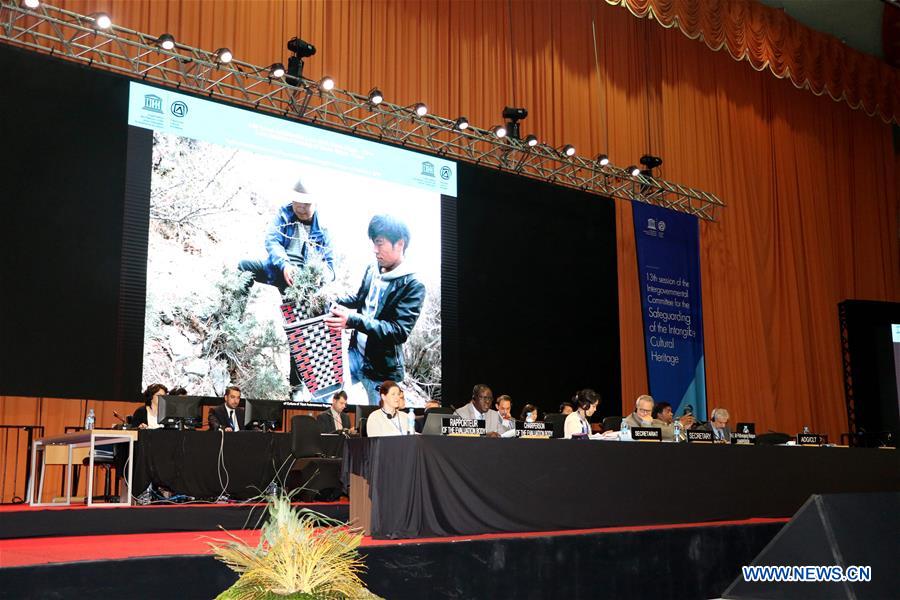
The introduction video of China's Lum medicinal bathing of Sowa Rigpa is being shown to delegates at the 13th session of the UNESCO Intergovernmental Committee for the Safeguarding of the Intangible Cultural Heritage in Port Louis, Mauritius, Nov. 28, 2018. The United Nations Educational, Scientific and Cultural Organization (UNESCO) inscribed on Wednesday China's Lum medicinal bathing of Sowa Rigpa on the Representative List of the Intangible Cultural Heritage of Humanity. (Xinhua/Brahms)
LHASA, Nov. 28 (Xinhua) -- Padma Yangdron, director of the Tibetan Medicine Hospital of Tibet Autonomous Region, is thrilled that Tibetan medicinal bathing is now a UNESCO intangible cultural heritage.
The United Nations Educational, Scientific and Cultural Organization (UNESCO) inscribed on Wednesday China's Lum medicinal bathing of Sowa Rigpa on the Representative List of the Intangible Cultural Heritage of Humanity, at a convention held in Port Louis, capital of the Republic of Mauritius.
"The successful inscription of Sowa Rigpa allows more people in the world to be aware of Tibetan medicine, accept it and hopefully benefit from it," Padma Yangdron said.
In Tibetan, "Lum" indicates the traditional knowledge and practices of bathing in natural hot springs, herbal water or steam to adjust the balance of mind and body, to ensure health and treat illnesses.
Sowa Rigpa, the Tibetan name of the medicinal practice, literally meaning the knowledge of recuperating, was originated on the Qinghai-Tibet Plateau with an average altitude of 4,000 meters above the sea level.
The traditional Tibetan medicine prescriptions of treating illness with herbs and minerals date back 2,500 years. In ancient times, Tibetan practitioners (known as Manpa in Tibet) collected animals, plants and ore to use as ingredients to cure diseases.
Tibet's traditional Karma Dulpa Festival (bathing festival), which takes place in the seventh or eighth month of the Tibetan calendar, is a week-long event highlighting the traditional culture including the medicinal practice as well as Thangka painting, carving and epic poetry chanting.
Most places in Tibet are high and cold year round. As a result, rheumatic diseases are very common among local farmers and herders. Medicinal bathing and the unique environment are inseparable.
Drolma, a doctor with the hospital, said medicinal bathing has curing effects for dozens of illness including rheumatic diseases, neurogenic diseases, arthritis, skin diseases and gynecological diseases.
Two newly-built three-story buildings in the hospital will be used for medicinal bathing therapy soon.
Migdrol, 53, is a national-level intangible cultural heritage inheritor of Sowa Rigpa. He said he inherited the practice from his father, a prestigious Manpa in Shannan, Tibet.
The Tibetan areas in Tibet Autonomous Region and Qinghai Province have preserved the inheritance mode from master to apprentice to sustain the practice.
Migdrol said he has passed on the practice to six of his disciples.
"We will sustain and develop the patrimony left by our ancestors," he said.
China now has 20 institutes for training Tibetan medicine practitioners. The Traditional Tibet Medicine School is China's only specialized institute of learning on the practice. There are 1,600 students on campus.
Migyur Tsomo, an associate professor at the school, said the traditional Tibetan medicine has become more and more recognized by the international community.
The classic book on Tibetan medicine, the Four Volumes of Medicine, has been included as China's national file and literature heritage this May.
"Tibetan medicine is an important part of Tibetan culture and Tibetan people's daily life, as well as traditional Chinese culture. My hospital will adhere to the UN conventions and work for the protection and development of traditional Tibetan medicine," Padma Yangdron said.