 ?
?
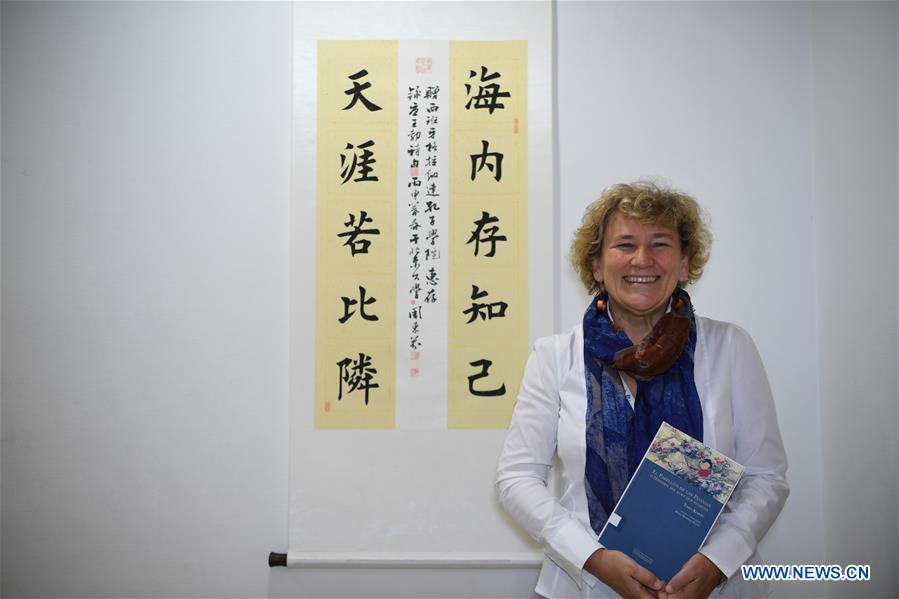
Alicia Relinque, director of the Confucius Institute of Granada University, holds her translation work, The Peony Pavilion by Tang Xianzu, at the Confucius Institute of Granada University in Granada, Spain, on Nov. 13, 2018.?(Xinhua/Guo Qiuda)
by Javier Ureta, Guo Qiuda
GRANADA, Spain, Nov. 27 (Xinhua) -- Having been translating some of the most precious ancient Chinese literary works to Spanish for decades, Alicia Relinque has found the key to happiness in her life.
"It is the Chinese literature," said Relinque, director of the Confucius Institute of Granada University. A modest and peaceful lady in her 50's, the professor easily becomes eloquent when talking about Chinese culture and classic literature.
Relinque's translation works include The Peony Pavilion by Tang Xianzu in the 16th century -- a romantic play about a tragicomic love story, and The Orphan of Zhao -- a drama written in the 13th century similar to Hamlet.
When translating The Golden Lotus, a famous Chinese novel composed during the Ming Dynasty, she slept only six hours every day in six years because she spent lots of time reading piles of documents about Chinese politics, history and society during that period of time.
Thanks to Relinque's efforts, those classical Chinese literary works have been translated into Spanish for the first time.
"It was a pleasure to spend hours studying. Sometimes you suffer because of the work that translating involves, but I also enjoy it and hope I can help others enjoy it as well," Relinque told Xinhua.
Born in Madrid in 1960, Relinque's bond with China started with Bruce Lee's martial arts movies, which fascinated her so much.
She began studying Chinese in 1976 and enjoyed it greatly. After she got to know Chinese literature, she wanted to share the beauty of this language with more Spaniards because at the time hardly anyone in Spain read Chinese literature.
Relinque got a law degree at the Universidad Autonoma del Madrid but spent a lot of her spare time studying Chinese. She studied Chinese in Paris for some time and then was awarded a scholarship in 1985 to study in Peking University for four years.
"I arrived in Beijing on August 15th," said Relinque. She initially found life difficult, but nevertheless felt "totally happy." As she adapted to life in China, she began a "marvelous" period of learning.
"I felt culturally at home. It may seem odd, but the Spanish are not as different from the Chinese as we think. We like to eat and to talk, and we also have very similar concepts of family relations," she said.
At the time when few foreigners went to China, Relinque was wandering in Beijing's alleys and discovering the Chinese ancient culture in historian documents.
She later returned to Madrid to work as a teacher because "nobody knew anything about Chinese literature" then.
After getting her doctorate, she learnt that the University of Granada was opening a department in Asian studies, so she moved to the city in south Spain in 1994 and has stayed there ever since.
She started the Chinese classical literature study in Spain, and therefore made the University of Granada a major place of sinology in the country. Now Relinque teaches Chinese literary theory and criticism, Chinese theater and cinema, and general theory of Chinese language and literature.
She attributes her love of Chinese literature to the depth of the personalities, the intensity of the emotions and the natural beauty highlighted in hundreds of Chinese stories she has read.
"In Tang Xianzu's work I found that China in the 16th century was quite similar to Spain at that time. It was the beginning of the development of commodity economy and it was the time of the awakening of personalities of young people who were seeking free love. It was the greatness of Tang's work," said Relinque.
Given her extraordinary work in translating Chinese classic literature, Relinque was granted a special award by the Chinese government in 2017.
"I try to let my students see the complexity which dominates nearly all of the literature which comes from China. I hope I can help them feel the same happiness that it gives me," said the professor.
"I want to show them that despite the distance between our countries, the Chinese are not distant or closed, but incredibly welcoming," Relinque said.
Now Relinque travels to China several times every year. She is witnessing the development of the ancient civilization nowadays.
"Spain should pay more attention to China, and on the other hand, I ask my students to study Chinese history, because the country's today and future lie in history," said Relinque.