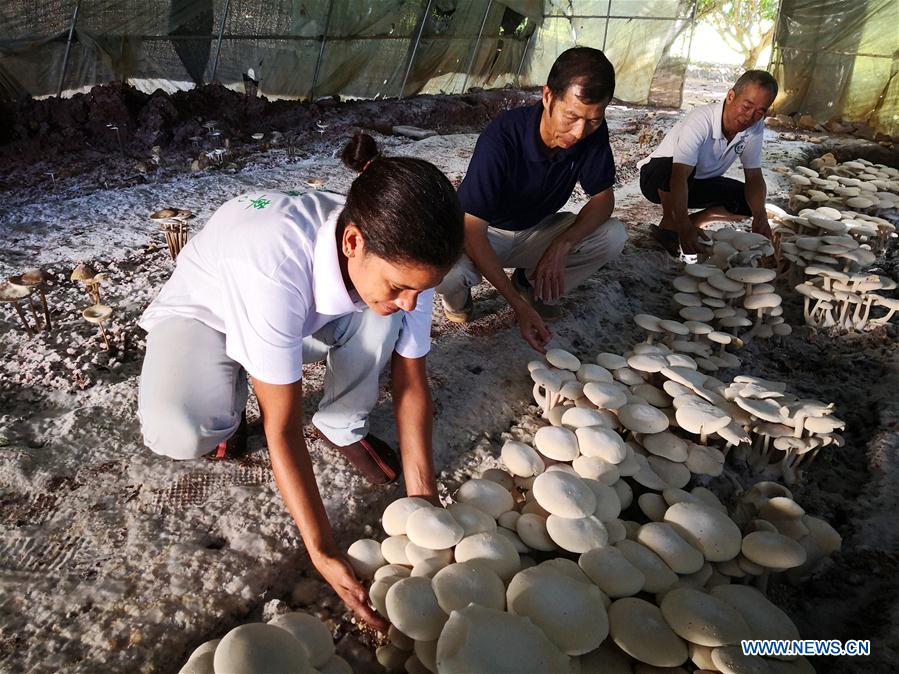
Chinese experts and Fijian workers check mushrooms in Nadi, Fiji, June 12, 2018. Juncao, a kind of grass introduced from China, has been bringing tangible benefits to Fijians, as it not only helps develop a low-cost mushroom cultivation industry, but also produces cattle feed and minimizes soil erosion in the Pacific island nation. (Xinhua/Zhang Yongxing)
By Xinhua writer Zhang Yongxing
SUVA, June 16 (Xinhua) -- Juncao, a kind of grass introduced from China, has been bringing tangible benefits to Fijians, as it not only helps develop a low-cost mushroom cultivation industry, but also produces cattle feed and minimizes soil erosion in the Pacific island nation.
The Juncao technology (Jun means fungi and Cao means grass) was invented in the 1980s by Lin Zhanxi, a professor at China's Fujian Agriculture and Forestry University, who is also the chief scientist for the China-Fiji Juncao Technology Cooperation Project which was established in 2014 after the Chinese and Fijian governments inked an agreement to start the agriculture cooperation.
"I am happy that Juncao technology has opened my eyes and has helped me become a project technician after being trained twice in China since 2016," Sunita Vikashni Lata, a technician working for the Juncao project for three years, told Xinhua.
"I really did not know the technique of cultivating mushroom until I began working here," the young lady said, adding that Juncao technology has a bright future in Fiji and other South Pacific island small states.
Sunita Vikashni Lata has also started her own small business of mushroom cultivation at home for nearly two months. She expressed the hope that with the help of her Chinese colleagues here, her business of mushroom cultivation will be better and better in the coming years.
Lin Zhansen, leader of a 8-member Chinese expert team of the project based in Nadi, Fiji's third largest city, told Xinhua recently that Juncao technology allows farmers in developing countries, including small island developing states like Fiji, to grow as many as 11 types of nutritious mushrooms from dried, chopped grasses, without cutting down trees and damaging the environment.
In addition, the technology can also be used for producing cattle feed and minimizing soil erosion to combat desertification, he said, adding that in the long run, depending on local demands and the scale of production, it may also provide opportunities for exporting the mushrooms cultivated using the technology.
"Juncao technology provides a new way with ecological and economic benefits for environmental protection, employment improvement and poverty alleviation," Lin said, noting that Juncao Industry can be a sustainable, environment-friendly emerging industry for the small island states like Fiji.
According to Lin, nearly 1,000 Fijian farmers and technicians have been trained over the past years and their project has been warmly welcomed in the country and Fijian leaders like President Jioji Konrote and Prime Minister Voreqe Bainimarama have visited their research station and praised the Chinese expert team for what it has done for the Fijians.
Adrian Joseph Ram, CEO of Fiji's Yaqara Pastoral Company limited, told Xinhua in his Yaqara Pasture, more than 100 km from Nadi, that nutritious Juncao has really helped his company and will surely have great potential.
"In Fiji, we have several months of dry season every year, and it is usually the bad time for the cattle as the natural grass will wither and die in this season. But Juncao is different; it is still green and fresh in the dry season now," he said.
"With the help of the Chinese expert team, we have learnt how to plant Juncao. So far we have planted a total of 10 acres of Juncao and we also plan to plant another 25 acres of Juncao in the years to come. Juncao will help our cattle to have happy time and high quality beef," said the man of Fiji's largest such company with about 5,000 cattle.
Chinese Ambassador to Fiji Qian Bo said that there is an old Chinese saying -- Give a man a fish and you feed him for a day; teach a man to fish and you feed him for a lifetime.
China's development assistance provides not only materials and infrastructure, but also capacity building. Apart from the Juncao project, China also implemented the rice technical cooperation project to help Fiji ensure food security and promote the mechanization of agricultural production.
Each year, the Chinese side provides nearly 100 training opportunities for Fiji, covering areas such as agriculture, climate change, and government management. Up to now, more than 1,000 Fijian officials and technicians have been to China to attend various seminars and technical training courses.