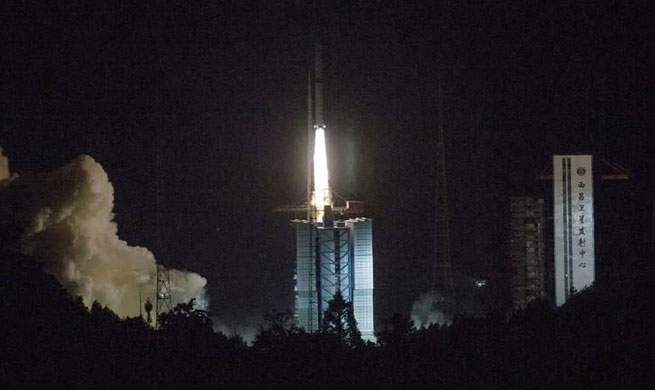
XICHANG, May 21 (Xinhua) -- China launched a relay satellite named Queqiao (Magpie Bridge) early Monday to set up a communication link between the Earth and the Moon's far side.
The satellite will enter a halo orbit around the second Lagrangian Point (L2) of the Earth-Moon system and play a vital role in China's Chang'e-4 lunar probe, which is expected to be the first-ever soft-landing probe on the Moon's far side later this year.
China's lunar exploration program is named after the legendary Chang'e, the "Moon Lady" who took a potion and floated into the sky, eventually landing on the Moon, where she became a goddess accompanied by a jade rabbit.
China's three-stage Chang'e lunar exploration program, starting in 2004, includes orbiting and landing on the Moon, and bringing samples back to Earth. So far, China has sent four spacecraft to orbit or land on the Moon.
CHANG'E-1
China's first lunar probe Chang'e-1 was launched on Oct. 24, 2007, making China the fifth country to develop and launch a lunar probe on its own.
Orbiting 200 kilometers above the Moon, it mapped 3D images of the lunar surface, analyzed the distribution of elements, measured the depth of lunar soil, and explored the environment between the Earth and the Moon. Chinese scientists acquired the first complete map of the Moon's surface, thanks to Chang'e-1.
After orbiting the Moon for about 16 months, the probe made a controlled crash on the lunar surface in March 2009.
Chang'e-1 opened up a new age of deep space exploration for China.
CHANG'E-2
Chang'e-2, which blasted off on Oct. 1, 2010, gained a full lunar map with a spatial resolution of 7 meters, showing more detail of the lunar surface than its predecessor, Chang'e-1, which had a resolution of 120 meters.
The probe also took pictures of the Sinus Iridum, or the Bay of Rainbows, the proposed landing site of Chang'e-3.
After accomplishing its tasks, Chang'e-2 flew to the L2 point of the Sun-Earth system, where gravity from the Sun and Earth balances the orbital motion of a satellite, to conduct scientific experiments.
It was then tasked to fly by the Toutatis asteroid, about 7 million km from the Earth. Chang'e-2 came to 3.2 km from Toutatis and captured images with a spatial resolution of 10 meters at a relative velocity of 10.73 km per second.
It then continued into deep space, becoming a man-made asteroid in the solar system.
CHANG'E-3
Chang'e-3 was launched on Dec. 2, 2013, and softly touched down on the Sinus Iridum 12 days later. It was the first Chinese spacecraft to soft-land on and explore an extraterrestrial object.
The success made China the third country, after the United States and the former Soviet Union, to soft-land on the moon.
Chang'e-3 included a lander and a moon rover called Yutu (Jade Rabbit), which took photos of each other while the rover circled the lander.
The probe acquired a geological profile of the Moon, and detected the geological structure from the lunar surface to 330 meters beneath, discovering a new kind of lunar rock. The data could give scientists new insights into the evolution of the Moon.
An optical telescope installed on the lander conducted observations in the ultraviolet band of celestial bodies above the North Pole of the Moon.
Another instrument, an ultraviolet camera, obtained Earth plasma layer images, which could help forecast space weather and ensure the safety of communication on Earth as well as between Earth and spacecraft.
The rover, Yutu, suffered from a mechanical anomaly and stopped operating.
TEST CRAFT FOR CHANG'E-5
China launched an experimental spacecraft on Oct. 24, 2014 to test technologies to be used in the Chang'e-5, which is expected to bring Moon samples back to Earth.
The spacecraft, comprising a re-entry capsule and a service module, flew around the Moon for half a circle. After the re-entry and service capsules separated, the re-entry capsule approached the Earth's atmosphere at about 11.2 km per second.
The capsule was designed to "bounce" off the edge of the atmosphere to slow it, before re-entering again. The process has been compared to a stone skipping across water, and can shorten the "braking distance" for the spacecraft.
The return capsule touched down at the designated landing area in Siziwang Banner, north China's Inner Mongolia Autonomous Region, on Nov. 1, 2014.
The service module flew back to orbit the Moon for further tests, and reached the L2 point of the Earth-Moon system to conduct experiments.