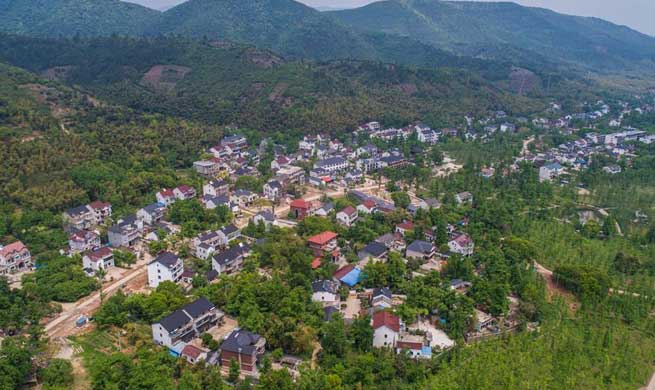
NANJING, April 23 (Xinhua) -- Huangqiao Township, once famed for its sesame cake, is now home to more than 230 violin companies, giving it a claim to the title "violin capital of China."
Twelve-year-old Li Kunyu in Huangqiao in east China's Jiangsu Province does not want to take over his parents' variety store or learn to make sesame cakes from his grandparents. He dreams of being a violinist instead.
He has been playing the violin for five years. Last year, when the local community held a Spring Festival gala, he performed the Chinese folk song "Jasmine Flower."
"There were over 300 people in the audience, including my parents. My mum held me tight and said she was so proud of me," he said.
Like Li, most of the students in the town of 200,000 can play the violin.
In the first and second grades at Huangqiao Primary School, a compulsory violin course is taught, and older primary students are free to choose whether to continue the course.
"The violin is our toy. We are all eager to play it well because every family here owns a violin, and they are even able to make this musical instrument," said Li.
According to Wang Xiaoyun, the town chief, over 30,000 employees produce around 700,000 string instruments here every year, including the violin, viola and cello, accounting for about 30 percent of all violins made worldwide.
She said that the annual output value of Huangqiao violins has reached 2.4 billion yuan (about 380 million U.S. dollars).
But why has the violin, more commonly associated with European music, taken root in a rural town in China?
In the 1960s, violin factories began to appear in cities like Beijing and Shanghai. Several Huangqiao natives who had made violins in Shanghai returned home and opened a small workshop.
Li Shu, 66, was an apprentice there at that time. In 1971, Li crafted Huangqiao's first violin.
Li is now the chairman of Fengling Musical Instruments Co., the largest violin manufacturer in the town.
Currently, his company exports violins to more than 80 countries, including the United States, Germany, and Italy, with the annual export sales reaching 20 million U.S. dollars.
"It's no easy thing to have Chinese-made 'Western musical instruments' enter the overseas market," Li said.
In early 1995, an American musical instrument company was preparing to participate in an expo. It needed 95 sample instruments produced within two months. Li seized the opportunity.
Normally, the task would have taken three months to finish. Li and his fellow craftsmen had to work overtime, and spent 53 days producing the high-quality samples.
"This cooperation won the American company's heart. By the end of that year, half of Fengling's products were sold to the U.S. market through the American company," he said.
Li adopts different marketing strategies to meet the needs of different markets. Western Europe, for example, demands high-quality instruments, while the Asian market seeks affordable violins.
At present, Fengling can produce nearly 120 kinds of violins, with prices ranging from hundreds of yuan to more than 100,000 yuan.
However, in Li's eyes, it is technological progress that has made violins in the town more competitive.
To make quality violins, the wood must be dried for more than 50 years, reducing water, sugar, and resin. Fengling invented a microbiological technology that can remove large amounts of impurities, shortening the drying time by over 20 years, Li said.
The violin industry has not just created jobs for Huangqiao residents, but enriched their lives outside of work as well.
After establishing a cultural and art center in cooperation with a local opera troupe, Fengling has trained more than 6,000 workers to play the violin, piano, guitar and other instruments.
Meanwhile, musical instruments have been promoted in five primary schools in Huangqiao.
Wang explained that local students not only learn about their hometown industry but also develop musical hobbies and help integrate Chinese and Western musical cultures.
Huangqiao plans to invest about 5 billion yuan in the construction of a musical theme town, covering an area of 3.8 square kilometers.
"Huangqiao will be a wonderland of violins, where people not only make instruments, but also enjoy the music," she said.