
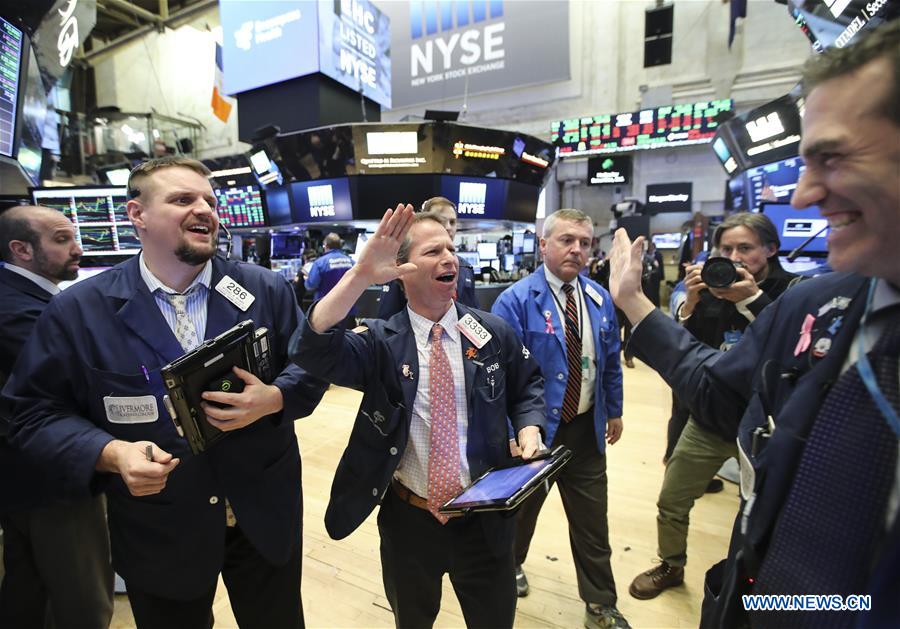
Traders work at the New York Stock Exchange in New York, the United States, Feb. 6, 2018. U.S. stocks closed higher after a volatile trading session on Tuesday. The Dow Jones Industrial Average added 567.02 points, or 2.33 percent, to 24,912.77. The S&P 500 increased 46.20 points, or 1.74 percent, to 2,695.14. The Nasdaq Composite Index was up 148.36 points, or 2.13 percent, to 7,115.88. (Xinhua/Wang Ying)
By Xinhua Writers Wang Wen, Wang Naishui
NEW YORK, Feb. 6 (Xinhua) -- U.S. stocks closed higher in volatile trading on Tuesday, as major indices tried to recover from the biggest one-day declines for the Dow and the S&P 500 in more than six years.
The Dow Jones Industrial Average added 567.02 points, or 2.33 percent, to 24,912.77. The S&P 500 increased 46.20 points, or 1.74 percent, to 2,695.14. The Nasdaq Composite Index was up 148.36 points, or 2.13 percent, to 7,115.88.
UNUSUAL VOLATILITY
Tuesday is marked by a return of volatility to the equities market that have been absent for quite some time.
The Dow traded in a near-1,000 point range throughout the session. It fell more than 500 points at the open, rebounded shortly afterwards to a 1 percent gain and then dipped nearly 2 percent before going back to green territory again.
Both S&P 500 and the Nasdaq followed the suit, both made more than 1 percent gain 10 minutes after the opening lower, and then swung up and down for the rest of the day.
The Cboe Volatility Index, Wall Street's fear gauge, rose to as high as 50.30 on Tuesday morning, the highest level since August 2015, before dropping back down to 37.51. But the level was still remarkably high compared to just a week ago.
The wild swing on Tuesday followed a steep sell-off which was considered a "flash crash" in the previous session.
On Monday, the Dow plummet nearly 1,600 points briefly in late trading, marking the worst intraday fall in market history. The index settled 1,175.21 points, or 4.60 percent lower while the S&P 500 slumped 4.10 percent on Monday, both erasing 2018's gains.
The steep sell-off started on Friday, when a stronger-than-expected jobs report suddenly reinforced investors' concerns of rising bond yields and higher inflation.
Total nonfarm payroll employment increased by 200,000 in January, and the unemployment rate stayed unchanged at 4.1 percent, stronger than market expectations, the U.S. Bureau of Labor Statistics reported Friday.
Average hourly earnings posted a 0.3 percent gain for the month and an annualized gain of 2.9 percent.
On Friday, the Dow plunged 665.75 points, while the S&P 500 and the Nasdaq dropped 2.12 percent and 1.96 percent respectively.
OVERDUE MARKET CORRECTION
As government officials and equity strategists have pointed out, the pullback is not related to anything related to economic fundamentals. Instead, it was a healthy market correction that is welcomed and long overdue.
The U.S. Treasury Secretary Steven Mnuchin said on Tuesday at a hearing of the House Financial Services Committee that the markets are "functioning very well," and the drop didn't pose any financial stability concerns.
He said the Trump administration's policies are very positive for long-term economic growth and that the administration still takes credit for stocks market rise as it went up for more than 30 percent since the presidential election day in 2016.
The Dow closed at 18,332.74 on Nov. 8, the election day, in 2016. The index has since rallied more than 8,000 points in a little more than a year's time, reaching its peak on Jan. 26 this year at 26,616.71.
U.S. President Donald Trump has repeatedly touted the bull market since his election as proof of his capability of managing the country's economy. He tweeted multiple times in 2017 when the Dow broke thousand-point milestones.
Market analysts attributed first half of 2017's bull market to Trump's election victory and his promises of a series of economic stimulus plan including relaxing regulations, cutting tax, and spending more on infrastructure. Wall Street called the period the "Trump Rally."
While the top equities stories for second half of 2017 were stronger-than-expected corporate earnings, U.S. economic growth and global economy recovery, Trump continued to take credit for the market on the way up.
He "played Santa" for the market just around the Christmas last year, when he signed the GOP tax bill in law on Friday, capping off a months-long effort to pass the legislation through the Republican-controlled Congress on Dec. 22.
The equities market has since entered into an even crazier rally, until last week, when fears that the market valuations were too high, the Fed would speed up interest rate hikes that would hurt corporate profitability, and that the bond yields were raising close to a warning level served as the catalysts for market sell-off.
Analysts said the investors' move to lock in profits, possibly some computer-programed trading, combined with concerns about interest rates have sent the equities into correction territory on Monday.
Even amid tremendous volatility in Tuesday' s session, equities strategists continued to say there is no reason to panic, calling the week-long sell-off overdue.
"U.S. equities have performed remarkably well since March 2009. While dramatic in the short term, today's price action is a healthy correction which is overdue," said Brendan Ahern, chief investment officer of the U.S. Krane Funds Advisors.
He told Xinhua that investors are rebalancing their portfolios from U.S. equities to more reasonably valued equity markets like China, Europe and emerging markets.
Peter Costa, President of Empire Executions, Inc., said while the slide looked terrifying, the market has been waiting for some kind of correction for some time, and Monday's pullback was "perfectly fine."
GLOBAL SELL-OFF
Equity markets followed the lead set on Wall Street Tuesday with stocks in Europe and Asia seeing significant losses as sentiment turned sour.
Overnight, Tokyo stocks closed sharply lower with benchmark Nikkei stock index plunging 4.73 percent in panic selling. The broader Topix index of all First Section issues on the Tokyo Stock Exchange, meanwhile, lost 4.4 percent.
All industry categories on the main section retreated, with metal product, nonferrous metal, and rubber product-linked issues comprising those that declined the most by the close of play.
The Hong Kong stocks closed down 1,649.80 points, or 5.12 percent, to 30,595.42 points. The benchmark Hang Seng Index traded between 30,577.83 and 31,286.03. Turnover totaled 258 billion Hong Kong dollars (about 32.99 billion U.S. dollars).
In Europe, Britain's major share index had its worst day since the Brexit vote. The FTSE 100 closed down 2.6 percent at 7,141.4 points. Volatility surged across the European market. The STOXX 50 Volatility index rose more than 60 percent at 30.18.
CAUTIOUSLY OPTIMISTIC OUTLOOK
The Federal Reserve Bank of St. Louis President James Bullard tried to talk down inflation worry on Tuesday.
He said continued strong labor market performance is unlikely to translate into meaningfully higher inflation, according to reports from Marketwatch.
Bullard said after Friday's jobs report showed surprising pickup in average hourly earnings, investors seemed to believe inflation would start to heat up and might force the U.S. central bank to quicken policy changes instead of raising benchmark interest rates at a gradual pace, according to media reports.
Similarly, J.P. Morgan said in a market commentary on Tuesday that while rates are moving higher, they remain at low levels compared to history. It added that there may be more room for rates to move higher before negatively impacting stocks.
Mark Haefele, global chief investment officer of wealth management at UBS, said in a note that the bank does not believe that now is a time to reduce exposure to stocks. He added that as long as the recent rise in bond yields moderates, the bank is confident that market conditions will remain orderly.
Costa told Xinhua that he did not think the sell-off would change the trajectory of the stocks market of the year.
"There is nothing serious to worry about. The fundamentals of the economies of the United States, West Europe and China are all there and all good... Tax cut is not going away," said Costa.