by Burak Akinci
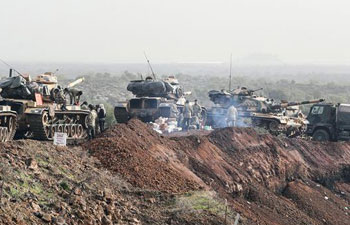
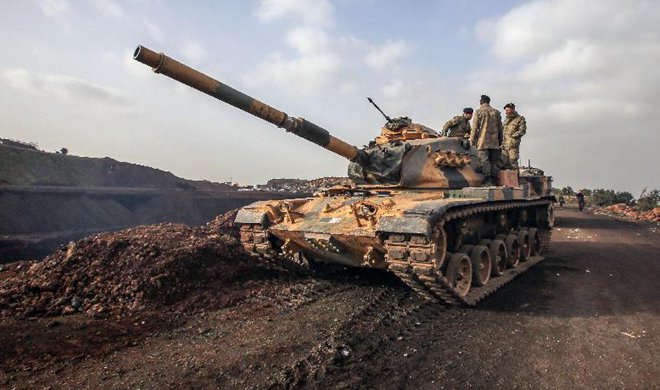
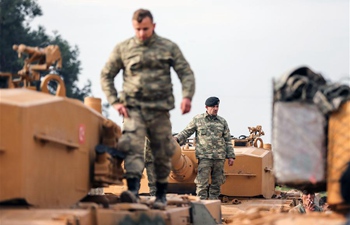
ANKARA, Jan. 22 (Xinhua) -- Turkey's offensive against U.S.-backed Kurdish militia in northern United States, said local experts.
The United States is facing yet another diplomatic dilemma in the Middle East, after its NATO partner's decision to launch a military operation against a Kurdish militia, which the Pentagon is openly arming but considered by Ankara as an affiliate of the outlawed Kurdistan Workers' Party (PKK).
The PKK has carried out three-decade insurgency in Turkey's Kurdish-dominated southeast. Ankara fears that it could create a de facto state inside Syria.
"The Turkish operation is the result of ill formulated statements from the United States. Turkey seems to have been obligated to do so after irrational declarations from the United States," said Tulin Daloglu, a Turkish journalist who has strong connections with U.S. political circles.
She is referring to U.S. officials' statements on a planned Kurdish-led "border security force (BSF)" to be established in the future in Syria along the 900-km border with Turkey.
The plan of sending "border force" to Syrian-Turkish border has angered Turkey. Turkish President Recep Tayyip Erdogan declared he would "kill the force before it is even born," and so he seemingly did.
No one know how long the operation, launched in defiance of U.S. warnings, will take, or its implications, however, Erdogan said that it will be wrapped up soon.
The BSF would be mainly constituted by the Syrian Kurdish People's Protection Units (YPG), supported politically and militarily by the United States since 2014 in the battle against the Islamic State (IS).
But U.S. growing support to the Kurdish militia consequently strained Ankara-Washington relations.
"The United States has made several mistakes since the beginning of the Syrian war. The decision to create a border force is the latest one," remarked Daloglu, calling the U.S. decision "a significant error of judgement" from Washington, who "has lost its chance to become a soft power" in a very volatile region where many conflicting and complex interests are at stake.
Washington has sought to placate the Turks. U.S. Secretary of State Rex Tillerson stressed that his country is not creating a border force at all, and a statement from U.S. army stressed that the new force will be "internally focused" on quelling remaining IS militants.
Russia, a key player in Syria, also denounced the so-called "border force," accusing the United States of having pushed Turkey to its limits.
"Unilateral actions" by the United States in Iran and Syria have infuriated Turkey, Russian Foreign Minister Sergei Lavrov told Kommersant newspaper in an interview.
"Many political scientists are asking why do we care and say that the worst is the best: let the United States prove its inability to find an agreement, (to show) its destructive role in global affairs, let it be in Iran or Syria and where the unilateral actions have already infuriated Turkey," he said.
Apparently in order to prevent the worsening of relations between the two NATO allies, U.S. Defense Secretary James Mattis reacted moderately to the Turkish offensive.
"Turkey was candid," Mattis said, without disclosing the U.S. reaction to Turkey's notification. "They warned us before they launched the aircraft they were going to do it, in consultation with us."
"Turkey has legitimate security concerns," Mattis said, noting it was the only NATO ally with an active insurgency inside its borders.
At the same time, Mattis said the U.S. military was deployed in Syria in a way to ensure that U.S.-provided weaponry was being used to battle insurgents, not Turkey.
That argument, however, has failed to soothe Ankara's concerns. Erdogan on Sunday accused the United States of having provided "planeloads and truckloads of weapons and munitions" to YPG fighters.
Some political analysts think on the other hand that the Turkish assault does not necessarily contrasts with U.S. interests in Syria.
"Honestly, I am one of those who think that the United States is pleased with Operation Olive Branch," argued Kerim Has from the University of Moscow.
"Even though Turkish-U.S. relations have indeed entered a new period of tensions, this process can accelerate the realization of Washington's plan in the region controlled by the Russians," he said.
It would also deter Turkey's attention from northeastern Syria where U.S. forces are deployed along territories controlled also by the YPG, he told Xinhua.
Has pointed out that the United States seems to bet on a possible clash of interests in Afrin between Ankara and Moscow, the latter which everyone argues has given a tacit green light to Turkey to push into Syria with air and land forces.
"While there is every possibility that a political negotiation will be held in 2018 in Geneva, the United States foresee and even aspire in a way of grinding down Turkey militarily," said Has.
Washington's decision to form a controversial border force is not only criticized in Turkey but also at home, where several columnists have warned of its adverse impact on ties with Turkey.
"Who authorized this strategic commitment, of indefinite duration, in Syria, when near two decades in Afghanistan have failed to secure that nation against the return of al-Qaida and IS?" asked U.S. conservative political commentator and author Pat Buchanan in a recent article.
"Will they (the U.S. people) support a clash with NATO ally Turkey, to keep armed Kurds on Turkey's border, when the Turks regard them as terrorists?" noted Buchanan, pointing out that "the Turks have a vital interest in keeping armed Kurds out of their border regions adjacent to their own Kurdish minority."
For Turkey, the idea of an autonomous or independent Kurdish entity in Syria, along its border, is an existing threat for its national security.