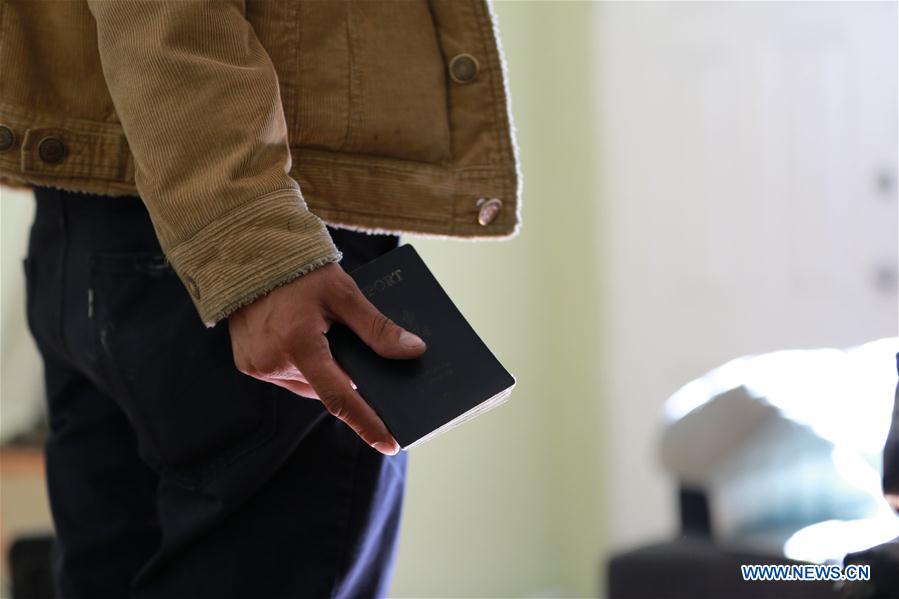
Hector Aguilar prepares to leave home with his passport in hands, Tijuana, Mexico, Jan. 11, 2018. Hector Aguilar is a U.S. citizen who works in San Diego, California, but lives across the border in Tijuana, in North Mexico's Baja California state. Aguilar travels almost daily from one side of the closely watched border to the other, as naturally as most people walk from one side of the street to the opposite. A long and well-guarded fence with just three gateways divides the two cities, a market of 6.5 million people and an economy that generates 230 billion U.S. dollars a year, according to Mexico's Foreign Ministry.(Xinhua/Xu Rui)
By Luis Brito and Wu Hao
TIJUANA, Mexico, Jan. 19 (Xinhua) -- Hector Aguilar is a U.S. citizen who works in San Diego, California, but lives across the border in Tijuana, in North Mexico's Baja California state.
Almost daily, the 32-year-old travels from one side of the closely watched border to the other, as naturally as most people walk from one side of the street to the opposite.
Aguilar, whose parents are Mexican, said he has spent his entire life going back and forth between the United States and Mexico. He was born in Los Angeles, spent childhood in Tijuana and afterwards and graduated from high school in San Diego.
As an adult, Aguilar chooses to live in Tijuana because he finds it both economical and entertaining. He carries a U.S. passport and a mobile phone with a U.S. number, but tells people he is a Mexican.
"There's nothing better than saying you are from Tijuana, because saying you are from elsewhere, like San Diego, sounds boring," Aguilar said, laughing.
Aguilar is among the thousands of residents living along the dynamic Tijuana-San Diego border, which boasts one of the world's busiest traffic points, with 30 million crossings a year.
A long and well-guarded fence with just three gateways divides the two cities, or together a market of 6.5 million people and an economy that generates 230 billion U.S. dollars a year, according to Mexico's Foreign Ministry.
Between 70,000 and 100,000 people of both nationalities cross from one city to the other for study or work, Rodolfo Figueroa, a National Immigration Institute (INM) delegate in Baja California, told Xinhua.
"It's a metropolitan area that comprises San Diego and Tijuana, and the border is an obstacle within the city. It's not just a feature of an international border, it's an integral part of daily life," said Figueroa.
Aguilar rents a comfortable apartment on a central street in Tijuana, within walking distance from the city's prestigious cultural center and a popular movie theater. He pays 300 U.S. dollars a month in rent, a quarter of the cost for a comparable apartment in San Diego.
"I can work and study in the United States without paying a huge rent. Life is expensive there. I feel more free, there are always things to do," he said. "I don't know, it's like a gift."
The El Chaparral-San Ysidro pedestrian crossing point is close to his home, and he passes through it three or four times a week to study photography at the San Diego City College. He also works part time there, spending 12 hours a week delivering packages.
The commute only takes him about an hour, including the 10 minutes spent crossing the border on foot, plus the 45-minute ride on a trolley car to the campus located in downtown San Diego.
As a photography enthusiast, he appreciates the contrast presented by Tijuana, where prosperity and poverty exist side by side. Affordable medical services catering to Americans thrive, while blocks away, communities of deported undocumented migrants live in squalid conditions.
The city halls of San Diego and Tijuana came together nearly five years ago to jointly promote business in the region, which they call "CaliBaja."
They pushed their federal governments to facilitate the border crossing of personnel and merchandise, and succeeded in getting a pedestrian bridge built to connect Tijuana's airport with San Diego.
"It's the result of our being neighbors and of the reality of the border," said Figueroa.
"Here in Baja California, for decades we were closer to the United States than to the center of the country," he said.
Like Aguilar, Hazell Sepulveda lives a life on both sides of the border. It takes the Tijuana resident five minutes to cross the Otay crossing point before dawn every day before working at the kitchen of a McDonald's just 500 steps from the border.
Sepulveda, 26, was born in San Diego to Mexican parents, but spent only two years of her life there.
For her, the border doesn't present much of an obstacle. "They never ask me anything, only where I'm going and if I'm bringing in something from Tijuana," she said.
In the morning, her husband drops off their five-year-old daughter, who was also born in San Diego, at a nursery before crossing the border for work at a manufacturing plant.
According to Sepulveda, all of her colleagues have a similar trans-border lifestyle, preparing some 1,000 hamburgers a day. They can hardly find a job in Mexico that pays 450 U.S. dollars a week, though living in the United States isn't appealing.
"The streets seem sad to me, they are empty" compared to the hustle and bustle of a typical Tijuana roadway, she said.
People like Sepulveda are used to the existing border. U.S. President Donald Trump's proposal to erect a "big" wall between and his administration's crackdown on undocumented migrants represent a clash with the realities of their daily lives.
"The dynamic between Tijuana and San Diego is a dynamic that cannot be rolled back," according to Raul Benitez Manaut, a professor at the Center for North American Research at the National Autonomous University of Mexico.
He is optimistic that Trump's conservative federal policies will be unable to hold sway over regional or local authorities with opposing views.
"California is a sanctuary state, state and county officials are not applying Donald Trump's migratory policies," he said.