by Matthew Rusling
WASHINGTON, Jan. 19 (Xinhua) -- The Pentagon released the U.S. National Defense Strategy on Friday, shifting its focus, for the first time in over a decade, from fighting terror to preparing for what it believes is a threat from China and Russia. But the document is unlikely to impact overall U.S.-China ties, U.S. experts said.
"GREAT POWER COMPETITION" NOW PRIMARY FOCUS
While the United States will continue to fight terrorism, "great power competition -- not terrorism -- is now the primary focus of U.S. national security," said U.S. Defense Secretary Jim Mattis in a speech at Johns Hopkins University.
"We will continue to prosecute the campaign against terrorists, but great power competition -- not terrorism -- is now the primary focus of U.S. national security," Mattis said in the speech.
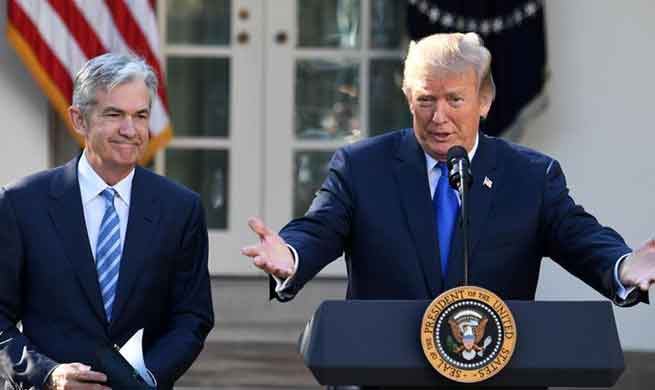
The new U.S. defense strategy mirrored the U.S. National Security Strategy announced by President Donald Trump in December, which outlined the U.S. government's military and foreign policies while naming China and Russia as "competitors."
The strategy is aimed at "restoring America's competitive military advantage to deter Russia and China from challenging the United States, its allies or seeking to overturn the international order that has served so well since the end of World War II," the Defense Department said in a statement released Friday.
The strategy seeks to implement "peace through strength, the affirmation of America's international role, the U.S. alliance and partnership structure and the necessity to build America's military advantage," in order to maintain what the department views as "key regional balances of power," the Defense Department said.
Briefing Pentagon reporters, Deputy Assistant Secretary of Defense for Strategy and Force Development Elbridge A. Colby said the strategy is not one of confrontations, but rather a "strategy that recognizes the reality of competition."
"The joint force should be ready to compete, to deter and -- if necessary -- to win against any adversary," Colby said.
The new outlook also represents a major shift in U.S. foreign policy, as the global fight against terrorism had dominated Washington's plans since the Sept. 11, 2001 terror attacks on New York and Washington, which killed nearly 3,000 civilians, and led to the U.S. wars in Iraq and Afghanistan. ( But now, the Trump administration believes China and Russia represent much more substantial challenges because of their ability to disrupt life on a grander scale, said Brookings Institution Senior Fellow Darrell West.
"Terrorists can score occasional triumphs by blowing up a dozen people, but they don't have the ability to wage war, take down critical infrastructure, or challenge America economically," West told Xinhua.
"Military planners worry that either China or Russia has the capability to do those things," West said.
"It doesn't mean these threats actually will materialize, but (means) that the country should be prepared for worst case scenarios," West said.
Tom Spoehr, director of the Center for National Defense at the Heritage Foundation, told Xinhua that the strategy shows the United States' "recognition that terrorism, although a significant problem, does not threaten the vital national interests of the United States."
STRATEGY UNLIKELY TO UPSET U.S.-CHINA RELATIONS
While the military's defense strategy is hawkish, experts said that may not cause a negative impact on U.S.-China relations, as the two countries have robust trade relations that make them economically dependent on one another.
"The military often has the most hawkish people so it is not surprising they take the toughest line on these issues. It doesn't mean the entire U.S. government has embraced those viewpoints," West said.
U.S. diplomats, on the other hand, are likely to take a different tone, analysts said.
"Diplomats typically take a softer tone and economic analysts understand the value of continuing a strong trading relationship with China. Each of those perspectives will act as a counter-weight to the administration's hawks and restrain action," West said.
"For the foreseeable future, I don't think this strategy will affect the U.S.-China relationship," West said.