by Xinhua writer Liu Liwei
HOUSTON, Dec. 26 (Xinhua) -- The U.S. energy industry revived in 2017 as oil prices kept rising steadily in the second half of the year. Experts believe growing American energy exports and China's rising energy demand will create unique opportunities for the two giant economies in 2018.
Crude oil prices rebounded from 42.06 U.S. dollars per barrel this summer to approaching 60 dollars toward the end of the year. Some major financial institutions, including the World Bank, have forecast that the prices would keep rising through 2018.
According to analysts, the Organization of Petroleum Exporting Countries (OPEC)'s decision to extend production curbs in a bid to shrink bloated inventories, and reduced U.S. crude inventories contributed to the price hike.
"The larger than expected drop in U.S. crude inventories together with the shutdown of a key North Sea pipeline continue to provide crude oil price positive movement following the OPEC and its allies, including Russia, recently (agreeing) to extend production cut through the end of 2018," Linhua Guan, chairman of the Houston-based Star Energy International Corporation, said.
The latest World Bank report showed that China's economy was in a steady pattern of growth in 2017. The growth rate for the year should be around 6.8 percent.
The oil demand from China in November was 9 million barrels per day, the second highest on record.
EMERGING U.S. ROLE
U.S. President Donald Trump has promised to revive the coal industry by rolling back environmental regulations and moved to repeal the curbs on carbon emissions from power plants imposed by his predecessor Barack Obama. Some observers believe this will boost traditional fossil fuel industries.
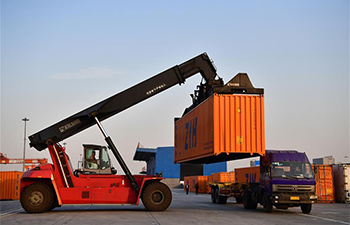
The United States has seen a prosperous year in 2017, when its crude oil, gasoline, diesel, propane and even liquefied natural gas (LNG) were shipped abroad at a record pace. Its exports are poised to expand further, giving OPEC a headache as the group restrains its own output.
Particularly, the strong demand from Latin America for U.S. distillate fuel will continue into 2018.
The United States lifted its four-decade ban on the export of crude oil to other nations in 2015.
While U.S. crude oil exports increased in 2016, it was not until 2017 when China became a major customer, that oil exports reached a whole new level.
China's appetite for American oil was huge. In April, China bought more than Canada did for the first time. Canada was once the only regular buyer of U.S. crude oil.
The addition of crude oil exports has both boosted the U.S. GDP and helped contribute to reducing its relative trade deficit with China.
Furthermore, U.S. LNG shipments are just warming up. The U.S. export terminal in the Gulf of Mexico saw a new high this year after its capacity was expanded. Mexico's demand for natural gas led all other countries in 2017, followed by South Korea and China. American LNG is even reaching the Middle East, typically a top supplier of the fuel.
INTERDEPENDENT RELATIONSHIP
There is great potential for the United States and China's cooperation in the energy field, John Hofmeister, a member of the U.S. Energy Security Council, said in a recent interview with Xinhua.
Hofmeister, former president of Shell Oil Company, believes that business is never one-way. "The U.S. and China need each other to prosper," he said.
The United States has abundant oil and gas resources, which China is short of, and the fast growth of the Chinese economy needs energy. That offers a good business opportunity for the U.S. energy sector, Hofmeister said.
"China is a wonderful market for North American natural gas," he said, adding that this spells opportunities to develop partnerships and business models that will work for both countries.
The bilateral energy cooperation is growing. During Trump's first state visit to China in November, Chinese and U.S. companies signed deals worth over 250 billion dollars, including energy pacts.
The size and scale of both economies require collaboration and partnership, which can benefit both and the global economy as a whole, Hofmeister said.
IMPLICATIONS OF U.S. ENERGY POLICY
Hofmeister said there is an obvious change in the energy policy of the current administration. Obama narrowed down American policy, focusing on alternative energy and renewable energy.
"I don't think Trump is excluding solar and wind in his policies, but he's putting oil and gas and coal back on the platform," he said. "It's a win-win for the world and society as a whole to approach energy in the fullest possible way."
Jon Taylor, professor of Political Science Department at Houston's University of St. Thomas, said Republicans have always pushed the idea of energy independence.
"The U.S. wants to not be reliant as it was 20, 30 or 50 years ago on Middle Eastern sources, arguing that those are unstable sources, and having American sources generate jobs in the U.S.," he said in a recent interview with Xinhua. "Reducing the cost of energy helps improve the economy."
Taylor said if the United States has to have foreign sources for energy, particularly for oil, "they're going to do whatever they can to protect those sources, which means the possibility -- as was the case 20, 30 and especially 40 years ago -- of oil specifically driving American foreign policy, particularly military policy."
As the U.S. foreign policy changes, Taylor thinks sustainable cooperation is the key to U.S.-China economic relations.
"There are a whole host of areas where we can have economic cooperation," he said.