Xinhua Headlines: Physical AI in spotlight at CES 2026, Chinese robotics gain attention

* Physical AI is a transformation that is reshaping industries and demanding unprecedented global collaboration.
* More than 1,000 Chinese technology firms participated in the event, many showcasing foundational models and platforms designed to accelerate the development of physical AI systems such as robots, self-driving cars or e-bikes.
* During the event, participants highlighted robust international cooperation as a key driver of AI advancement, while also mentioning parallel challenges in establishing universal standards for trust, safety, and energy efficiency.
LAS VEGAS, United States, Jan. 9 (Xinhua) -- The transition of artificial intelligence from a theoretical concept to widespread industrial application took center stage at the Consumer Electronics Show (CES) 2026, with the emergence of physical AI marking a new phase of technological evolution.
During the event, executives from leading global and Chinese technology firms gathered to examine the transformative potential and fundamental challenges of AI's rapid integration, highlighting China's contributions and collaborative role in reshaping global industries and daily life.
PHYSICAL AI
Physical AI is a transformation that is reshaping industries and demanding unprecedented global collaboration. NVIDIA Chief Executive Officer Jensen Huang introduced the concept during his keynote address, describing it as the next major phase in which machines begin to understand, reason and act in the physical world. "The ChatGPT moment for robotics," said Huang.
He underscored AI's growing importance as countries confront labor shortages driven by demographic decline, and positioned NVIDIA's Vera Rubin platform as the architectural foundation for this new era.
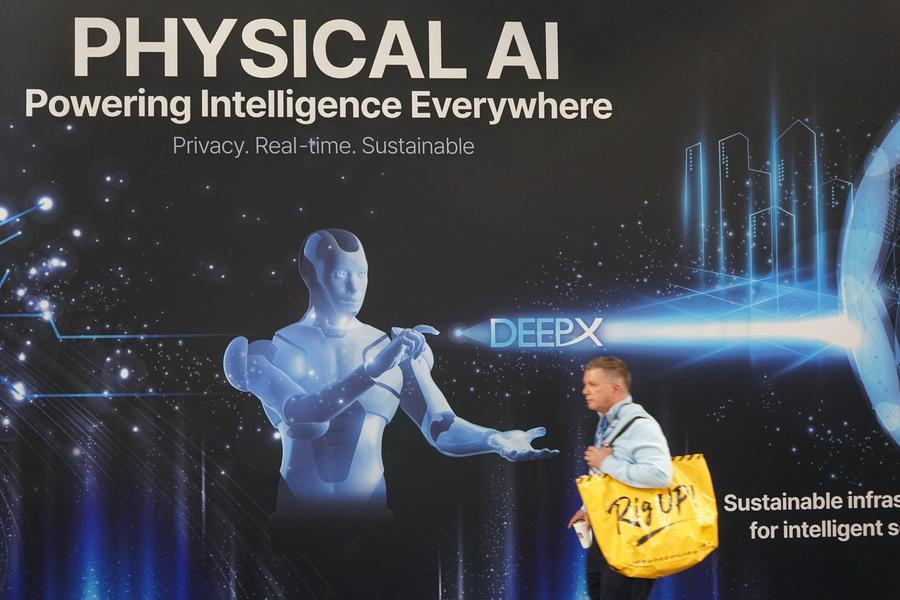
On Monday, NVIDIA announced new open models, frameworks and AI infrastructure for physical AI, and unveiled robots for industries from global partners.
The new NVIDIA technologies speed workflows across the entire robot development lifecycle to accelerate the next wave of robotics, including building generalist-specialist robots that can quickly learn many tasks, according to the company.
"NVIDIA's full stack of Jetson robotics processors, CUDA, Omniverse and open physical AI models empowers our global ecosystem of partners to transform industries with AI-driven robotics," Huang said.
Yang Yuanqing, chairman and chief executive officer of Lenovo, also discussed the concept of physical AI at CES, noting that the widely discussed idea essentially refers to "machines with brains."
With the rapid advancement of AI capabilities, machines are beginning to acquire the ability to perceive, understand and make decisions, he said.
Robots are expected not only to replace human physical labor but also to potentially assume certain intellectual tasks in the future, he said, adding that AI is driving the transformation of machines from "being able to work" to "being able to think and collaborate."
CHINESE ROBOTICS
More than 1,000 Chinese technology firms participated in the event, many showcasing foundational models and platforms designed to accelerate the development of physical AI systems such as robots, self-driving cars or e-bikes.
At the Hisense booth, the Beta companion robot, equipped with a new-generation AI intelligent recognition engine, conducted continuous "patrols," immediately transmitting warnings and real-time images to the cloud upon detecting intrusions or abnormal movement trajectories.
Nearby, Dreame Technology's "sweeping robotic arm" demonstrated human-like dexterity, not only cleaning floors but also sorting and tidying household items such as toys, socks and paper balls.
Yarbo, a company specializing in robotic yard maintenance systems, introduced its new "Modular Yard Robot," which features a core unit with multiple interchangeable modules designed for year-round tasks, including mowing, leaf blowing, and snow removal.
"This product aims to redefine outdoor and yard living, making laborious outdoor tasks simpler through automation and AI technology," Huang Zhiliang, co-founder of Yarbo, told Xinhua.
Shanghai-based startup BreakReal drew considerable attention with its conversational "AI Bartender." Users simply describe their mood or taste preferences, after which the system generates recipes in real time and directs the hardware to produce personalized cocktails.
Segway, a popular American brand owned by Chinese company Ninebot, is rolling out its fourth-generation robotic lawnmower.
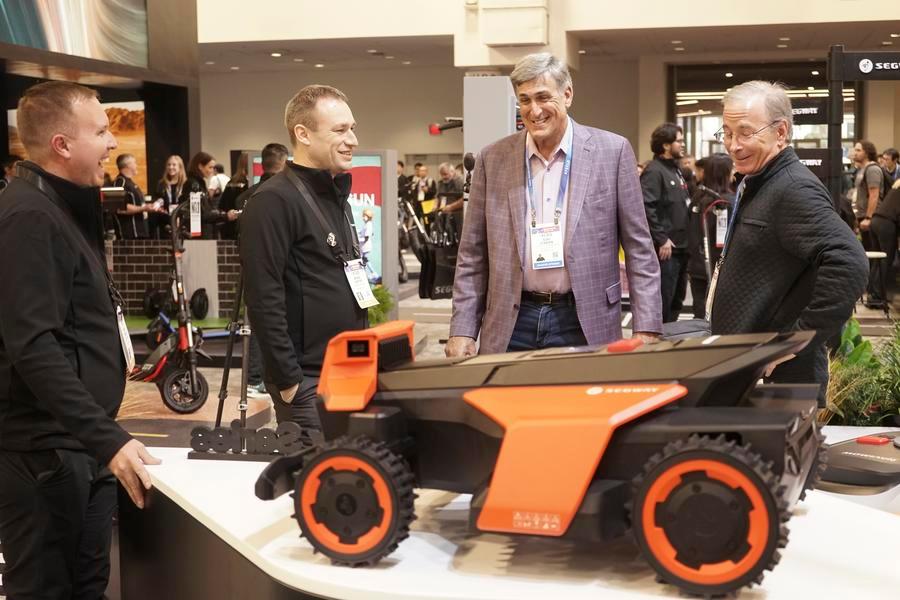
"You no longer have to line the perimeter of your yard with boundary wire, nor do you have to define the parameters for where it cuts in any other method," said Zhao Wei, president of Segway American Regional Headquarters.
"Using LiDAR, advanced cameras and other positioning technology, based on AI training, the new suite of robot lawnmowers can instantly determine where they should be mowing -- and avoid obstacles and areas like flower beds, even in darker shaded environments," he said.
INT'L COLLABORATION
During the event, participants highlighted robust international cooperation as a key driver of AI advancement, while also mentioning parallel challenges in establishing universal standards for trust, safety, and energy efficiency.
Jensen Huang, NVIDIA's CEO, highlighted the company's cooperation with Chinese and Chinese-linked partners in its supply chain and system-building ecosystem, noting that "every single major computer company" knows how to build these systems.
Huang described Chinese entrepreneurs, engineers, technologists, and AI researchers as "among the world's best." He said China's technology ecosystem is "very fast-moving" and pointed to the large number of startups, including those that have gone public and performed well, as evidence of a vibrant market.
NVIDIA also announced a strategic partnership with Siemens, revealing that the German company is using NVIDIA's Omniverse platform to develop industrial digital twins.
As AI adoption accelerates, a CES panel discussion on "AI Trust and Guardrails" underscored the critical challenges that must be addressed. Panelists emphasized that trust is not treated as a slogan but as "a combination of data control, operational constraints, oversight design, and measurement."
In healthcare, Abridge CEO Shiv Rao described trust as a "foundational requirement" because the sector involves risk and strict rules, requiring transparency, reliability, and credibility.
Enterprise data systems presented their own challenges, Snowflake CEO Sridhar Ramaswamy noted, adding that enterprises care about "where data is handled" and that data sovereignty concerns can require negotiation.
The automotive sector presented perhaps the most stringent safety requirements, with Mercedes-Benz Group CEO Ola Kallenius stressing that "safety demands a higher standard than consumer AI tools" and "road safety demands error intolerance."
Energy constraints were another challenge. The new wave of AI data centers will require large amounts of electricity, and "nothing is more important than ever" than energy efficiency, Huang noted. (Video reporters: Huang Heng, Tan Jingjing, Zeng Hui; video editors: Zhao Tianlin, Luo Hui, Zhang Yichi)■











Comments