Xinhua Headlines: China engineers safer, smarter flyways for birds on the move

* From stringent ecological conservation to an integrated, intelligent "space-air-ground" monitoring network and rigorous law enforcement for bird protection, China is rolling out an extensive system to ensure the safety of migratory birds and to strengthen coexistence between humans and nature.
* In June 2024, the government identified 1,140 important flyway sites, designated 821 key habitats and recognized 58 nationally important wetlands, laying out a comprehensive plan to build a conservation network for migratory birds. By 2030, it aims to bring 90 percent of key habitats under effective protection.
* China has ratified and implemented more than 30 environmental conventions, including the Convention on Biological Diversity, the UN Framework Convention on Climate Change and the Ramsar Convention on Wetlands, and has played an active role in advancing the Kunming Declaration, the Wuhan Declaration and the Kunming-Montreal Global Biodiversity Framework.
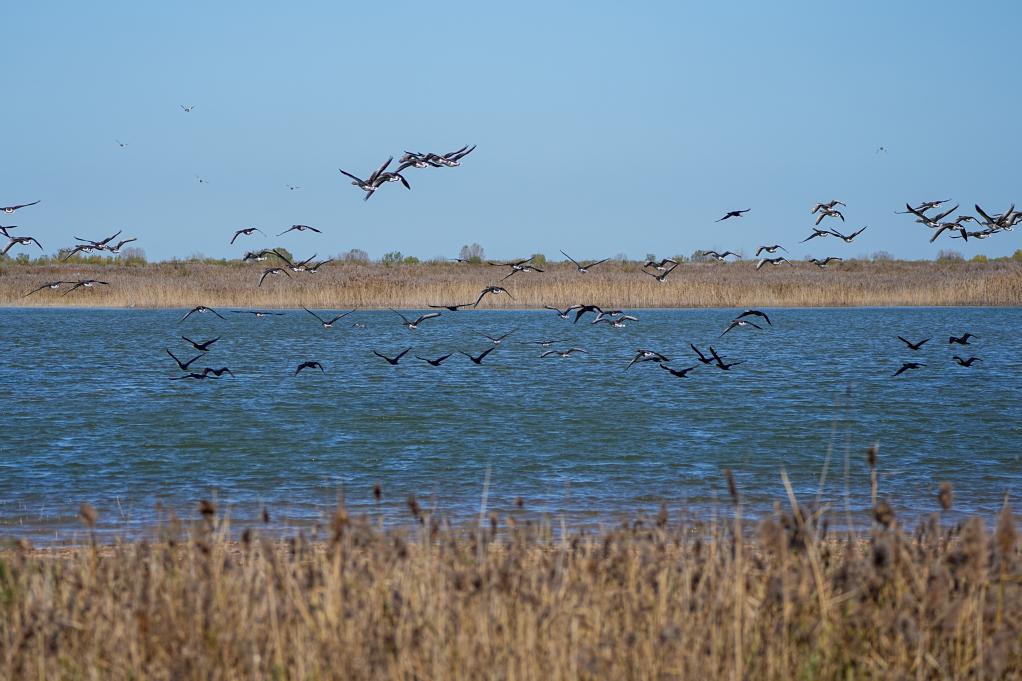
JINAN, Dec. 15 (Xinhua) -- In winter at the Yellow River estuary, hundreds of thousands of migratory birds take flight, their wings beating against the cold air like a rising tide across the sky.
Every year, more than 800 species of migratory birds worldwide travel along China's flyways, relying on the country's vast geography as a crucial segment of their long journeys.
From stringent ecological conservation to an integrated, intelligent "space-air-ground" monitoring network and rigorous law enforcement for bird protection, China is rolling out an extensive system to ensure the safety of migratory birds and to strengthen coexistence between humans and nature. The country's fast-growing "birdwatching economy" has become an unexpected beneficiary of this effort.
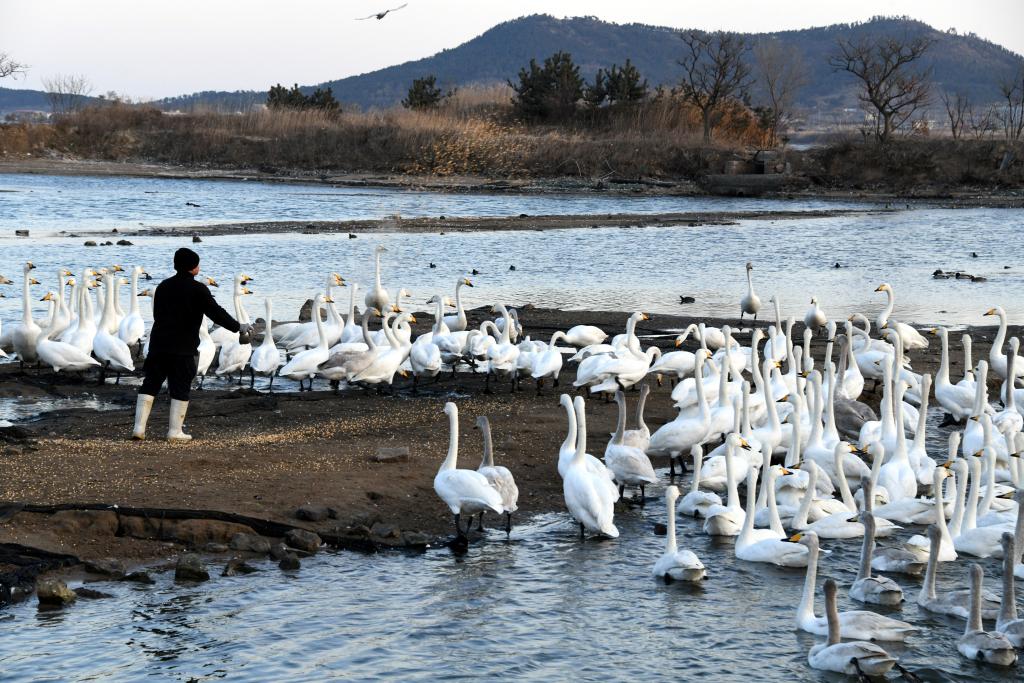
Every winter in Weihai, a coastal city at Shandong Peninsula's easternmost tip jutting into the Yellow Sea, resident Li Weimin looks skyward, hoping for a glimpse of "Da Bai" (or "Big White"), a whooper swan he once rescued.
In February 2020, Li found the bird curled in the grass with a severe wing injury. "I took off my coat and wrapped it carefully," he recalled. After months of nursing, he released Da Bai the following spring, but the bond remained.
Today, about 7,000 whooper swans winter in Weihai, one of China's most important habitats for the species. Li is now part of a volunteer team known locally as the "Blue Guardians," more than 600 strong, dedicated to protecting the birds' coastal refuge. "Watching them arrive and leave each year feels like keeping my promise, even if I don't see Da Bai," he said.
China is one of the world's richest countries in bird diversity, situated along four of the nine major migratory flyways globally. Each year, hundreds of millions of birds traverse its skies and wetlands.
In June 2024, the government identified 1,140 important flyway sites, designated 821 key habitats and recognized 58 nationally important wetlands, laying out a comprehensive plan to build a conservation network for migratory birds. By 2030, it aims to bring 90 percent of key habitats under effective protection. The country's Sanjiangyuan National Park and the Northeast China Tiger and Leopard National Park both serve as important breeding grounds for migratory birds.
Technology is playing a pivotal role in these conservation efforts. At 5:40 a.m. on March 19 this year, a crested ibis tagged as "162" lifted off from the treetops in Yanzhen Town, Shandong Province, and began an extraordinary journey. A miniature satellite tracker on its back, weighing just a few grams, recorded an 11-hour, 260-kilometer flight, including nearly 200 uninterrupted kilometers across the wind-lashed Bohai Sea, setting national records for both longest single-day and longest continuous flight by China's wild ibis population.
Across northern China, in the snowy expanse of the Tumuji National Nature Reserve in the Inner Mongolia Autonomous Region, an intelligent management system went online this year to monitor species including the wintering great bustard, cranes, and storks. Using geographic information systems, big data, AI and 3D visualization, the reserve now manages a seamless "space-air-ground" monitoring network.
"The system, powered by AI recognition algorithms, can count species, numbers and activity frequencies of key animals in real time," a staff member said. Drones equipped with AI can detect fire, smoke and human or vehicle intrusions, sending alerts instantly.
Jiang Hongxing, director of China's National Bird Banding Center, noted that monitoring once relied almost entirely on human observation, an approach limited by gaps and blind spots. The new flyway protection plan calls for satellites to scan wetlands from above, drones to survey sensitive areas at low altitude, and ground stations and cameras to provide precise identification and counting.

In the Huanglong National Nature Reserve in southwest China's Sichuan Province, a UNESCO World Heritage Site, the world's first high-altitude acoustic trail debuted in June after three years of research with the Shanghai-based Tongji University. Based on acoustic recognition, the system can accurately identify 59 species of songbirds, adding a powerful new tool for smart conservation.
The scale of the challenge, experts say, extends far beyond China's borders. "Bird conservation cannot be achieved by the efforts of a single country, for they soar freely across borders," said Myounghai Kwak, director of the National Migratory Birds Center at the National Institute of Biological Resources in the Republic of Korea (ROK), during a meeting on migratory bird protection held between Japan, Australia, China and the ROK.
China has ratified and implemented more than 30 environmental conventions, including the Convention on Biological Diversity, the UN Framework Convention on Climate Change and the Ramsar Convention on Wetlands, and has played an active role in advancing the Kunming Declaration, the Wuhan Declaration and the Kunming-Montreal Global Biodiversity Framework.
Public participation is emerging as a powerful complementary force. In Weihai's Yandunjiao Village, residents regard whooper swans as family members, with "protecting whooper swans" being written directly into the village charter. Former income sources such as aquatic processing plants and shipyards have been relocated.

Their efforts have been rewarded by the return of the birds and the influx of visitors. Shutterbugs, sketch enthusiasts and tourists now flock to the village, which has developed an ecotourism model built around winter swan watching, summer sketching, exploring centuries-old seaweed bungalows and enjoying fishermen's cuisine. More than 70 percent of local villagers now earn income from tourism. Last November, Yandunjiao was named one of the "Best Tourism Villages 2024" by the United Nations World Tourism Organization.
China's broader birdwatching boom is also reshaping rural economies. In Luoshan County's Dongzhai National Nature Reserve in Henan Province, birdwatching has powered industrial upgrading in nearby Lingshan Township. Sixteen birdwatching bases now employ 260 people, supported by more than 60 hotels and restaurants. About 40,000 birdwatchers visit annually, generating some 50 million yuan (about 7.1 million U.S. dollars) in revenue for locals.
"March to July is the peak," said local hotel owner Zou Xingqiang. "Our 18 rooms are almost fully booked. Birdwatching enthusiasts from Singapore, the ROK and Japan usually stay longer, and the guests eat, shop and use transportation. The whole chain is booming."
(Video reporter: Zhao Xiaoyu; video editors: Li Ziwei, Mu Xuyao, Roger Lott and Liu Ruoshi) ■












Comments