Feature: The mountains, the men, the murals: Guarding a lost kingdom on roof of the world

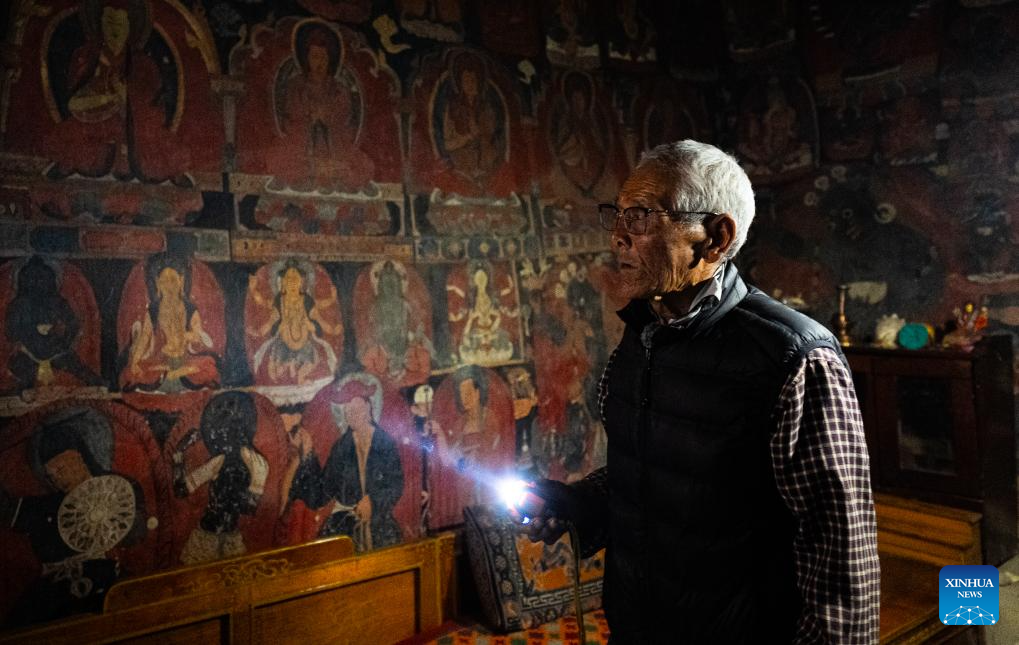
Rigzin Wangzhab checks on the Piyang grottoes lest there is any water seepage or collapse in Zanda County of Ngari Prefecture, southwest China's Xizang Autonomous Region, June 24, 2025. (Xinhua/Tenzin Nyida)
LHASA, Dec. 10 (Xinhua) -- On the roof of the world, where millennia have shaped the earth into colossal, unyielding sculptures, three pairs of weathered feet trace stubborn paths against the wind, their strides once firm but now unsteady, drawing faint, invisible lines between a fading past and an unknowable future.
It is not a tale of archaeologists with delicate brushes, but of shepherds, farmers and ordinary men who became the unintended custodians of enduring glow on the walls of ancient caves.
For nearly 40 years, Ngawang Milang, Qamba Cering and Rigzin Wangzhab have lived in quiet parallel to the majestic ruins of the ancient Guge Kingdom in Zanda County of Ngari Prefecture, southwest China's Xizang Autonomous Region. The ancient Guge Kingdom was probably founded in the 10th century, but it was abandoned by the end of the 17th century.
Their lives have been defined not by grand events, but by the ascent of the mountains, the seasons spent on vigil, and the gradual ebb of their own strength -- each sacrifice safeguarding a fragile legacy that would otherwise vanish into obscurity.
The journey of the first guardian began in isolation. In 1987, while the outside world hummed with transformation, Ngawang Milang, then in his 40s, turned his gaze toward the cliff face of Donggar. There was no official designation and no recognition, only a scatter of caves that locals spoke of as containing "paintings of celestial maidens." With no path to reach them, he made one.
"As a child, I used to roam around these caves," Ngawang said. "Now, I hope to pass them on to those who come after us."
When water seepage threatened the murals, Ngawang hauled sheets of plastic to the mountaintop at over 4,000 meters above sea level, alone. Through the brutal winters, his only companion was the trembling flame of a butter lamp, until he realized its soot was darkening the ancient pigments. He stepped back from the warmth, building a crude shelter beside the art he had decided to protect.
"I was there to guard the caves," the 82-year-old recalled, shrugging off the memory of cold. "If you're cold, you just bundle up."
His was a solitude forged by conviction, long before scholars arrived to affirm the caves' value. And when experts warned in the 1990s that camera flashes could damage the murals, the caution became his creed.
Back then, Ngawang himself did not fully understand the significance of the murals in the caves, yet he shouldered the responsibility so that someday, someone else might see and understand.
The solitary commitment stretched a few kilometers west to Piyang. There, guardianship came not through personal calling but by chance. In 1992, Qamba Cering's name was drawn in a village lottery. For years, it was simply a responsibility, another daily climb as routine as tending his sheep or working the land.
A few years later, personal loss carved its mark into the stones. After the passing of Qamba's wife, the empty house below the mountain transformed the vivid world of the caves into something else. The murals, crowded with deities, human realms and visions of eternity, became a quiet refuge.
"Perhaps somewhere my wife still exists, like the figures in these murals," he said. Duty slowly transformed into a quiet vow. "Piyang grottoes are the most beautiful place in my heart... protecting them is like guarding the roots of my home."
He was joined in 2002 by Rigzin Wangzhab. Together, the two formed a fragile, deeply human symbiosis. Qamba's eyes, worn down by decades of unfiltered plateau sun, now struggle in dim light. Rigzin's knees, battered by years of climbing the precipitous slope, bend only with pain and the help of a walking stick. One can no longer see the path clearly, while the other can no longer walk it with ease. Yet they became each other's equilibrium.
When Rigzin underwent a knee surgery in 2021, Qamba, for an entire month, made the perilous descent alone as daylight drained from the mountain. "I could walk this path even with my eyes closed," he said, a claim less of pride than of muscle memory, carved into him by time.
Their partnership was born of shared sacrifice, two "half-lives," as Rigzin's daughter Dechen Drolkar put it, holding up an entire mountain together. She runs a small teahouse at the foot of the mountain, offering meals and a place to rest for travelers.
Their long vigil did not go unnoticed. Gradually, the world they guarded began to look back. Researchers arrived, deciphering the "fairies" as priceless early Guge art and hailing the site as a "second Dunhuang." Preservation efforts followed, shifting from Ngawang's plastic sheets to full scientific stewardship: international collaborations, structural reinforcements and the painstaking replication of more than 2,000 mural images.
In 2013, the Piyang and Donggar grottoes were jointly listed as a national key cultural relics protection unit. The designation covers a wide range of significant remains from the Guge Kingdom, including grottoes, temple structures and castle ruins, some dating back as far as a thousand years.
As early as 2005, younger villagers had taken over the Donggar grottoes' daily watch. Yet Ngawang, his legs now unsteady, remained a quiet anchor from below, offering guidance shaped by decades of solitary care.
"I'm relieved," he said, gazing out from his window toward the Donggar grottoes on the distant cliff. "Finally, I don't have to worry that future generations won't get to see them."
At Piyang grottoes, the two old men witnessed a different kind of arrival: tourists. As visitor numbers swelled, Rigzin, now 77, became an unlikely bridge. He practiced Mandarin, and his earnest, approachable explanations turned mineral pigments into living stories.
"These paintings show food, ritual objects, musical instruments... the life of the Guge period," he would tell wide-eyed travelers, linking them to a heartbeat a thousand years old.
Qamba would lean against the cave entrance, listening to Rigzin's explanation, squinting at the murals. The details had long since blurred, yet a lifetime of guardianship had stitched the paintings into the very fabric of his life, and, in some quiet way, into his understanding of the world itself.
Some visitors came for the murals, while some came precisely to meet the men who had guarded them. "They are the guardians of the past, passing it on to the future," wrote a visitor online who had toured the Piyang grottoes.
"Now, more people can see the art our ancestors left. That's perfect," said Rigzin.
Below the mountain, his daughter's teahouse now hums with customers drawn by the growing flow of visitors, a quiet, tangible ripple from decades of unseen devotion.
Yet the mountain's call remains their true compass. Even after retiring from their posts in 2024, Rigzin and his contemporary Qamba, also 77, continue to climb. For them, the caves feel more like home than any place. The murals' colors remain as vivid as the day they first saw them, but the two men who guarded them have long since turned silver.
Rigzin said he wants to do a little more for their "second home" as long as he can move, while Qamba's devotion carries the gravity of a final vow in his words: "Perhaps one day, I will die on the road to watching over the caves."
Today, 252 local conservators in Zanda County safeguard Ngari's historical sites. The solitary vigil once held by Ngawang has grown into a community's calling. The three elders are slowly stepping back, their bodies finally yielding to time. Their hands -- crooked, calloused and shaped by a lifetime of climbing and careful tending -- have passed on an invisible torch.
But because of them, the whispers rising from these cliffs are no longer solitary.
"In the old days, when my legs were still strong, I went up almost every day. Now they really won't carry me anymore," Ngawang said, noting that he has only managed the climb three times this year.
As dusk settled, Rigzin and Qamba leaned on each other and made their slow descent. Rigzin's walking stick tapped against the stone steps -- tap, tap -- like a quiet metronome counting the passage of a thousand years. ■
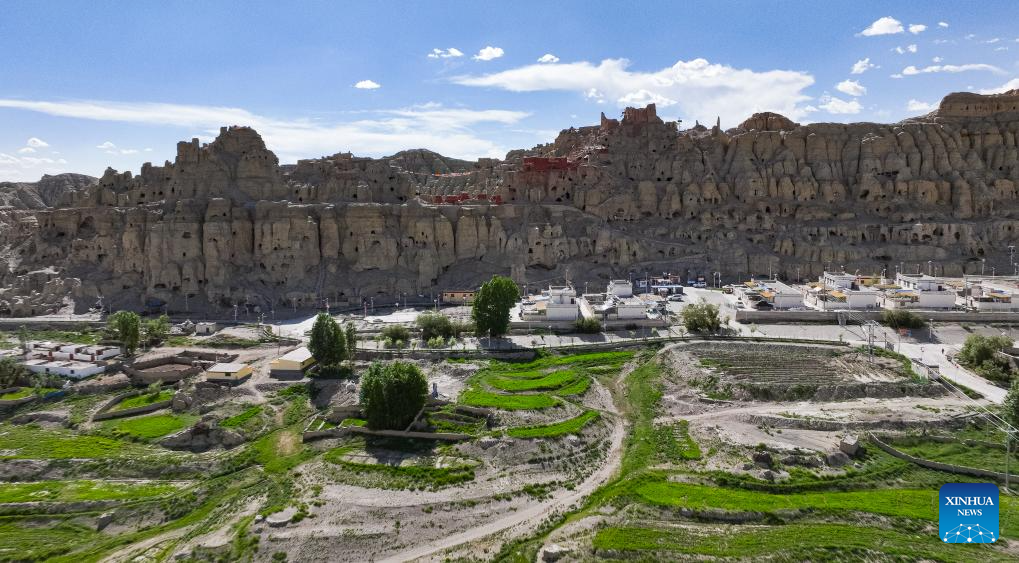
An aerial drone photo taken on June 24, 2025 shows the Piyang grottoes and a village below in Zanda County of Ngari Prefecture, southwest China's Xizang Autonomous Region. (Xinhua/Tenzin Nyida)
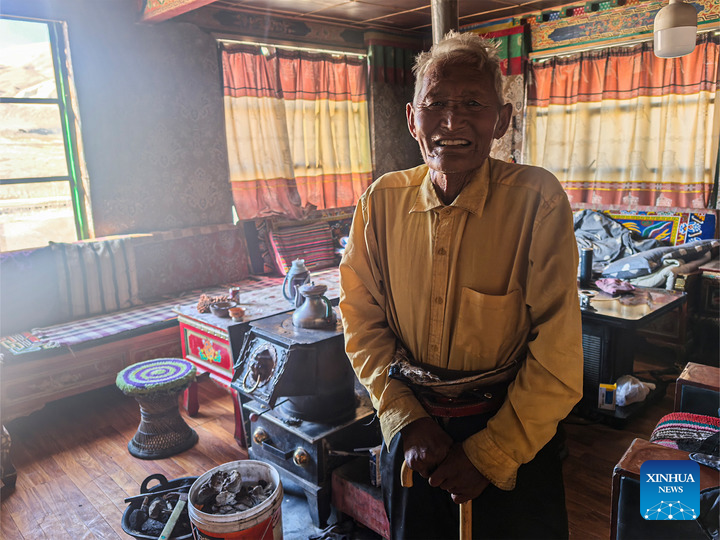
Ngawang Milang is pictured in Zanda County of Ngari Prefecture, southwest China's Xizang Autonomous Region, Nov. 16, 2025. (Xinhua/Lodro Gyatso)
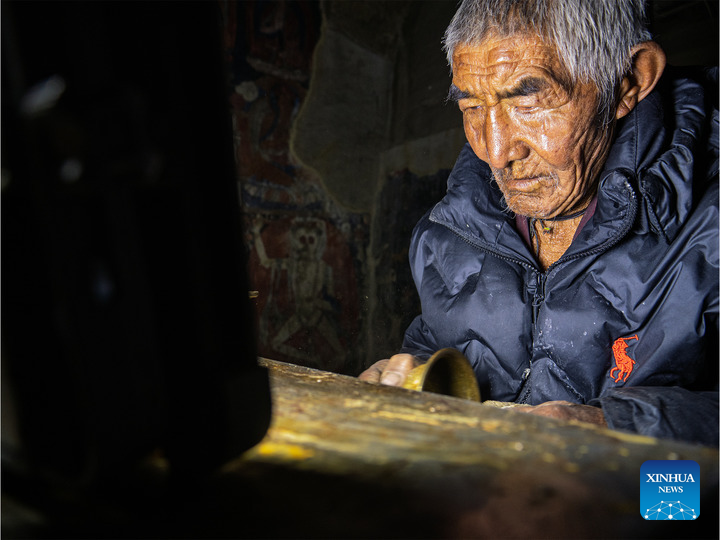
Qamba Cering is pictured in Zanda County of Ngari Prefecture, southwest China's Xizang Autonomous Region, Nov. 16, 2025. (Xinhua/Lodro Gyatso)


