




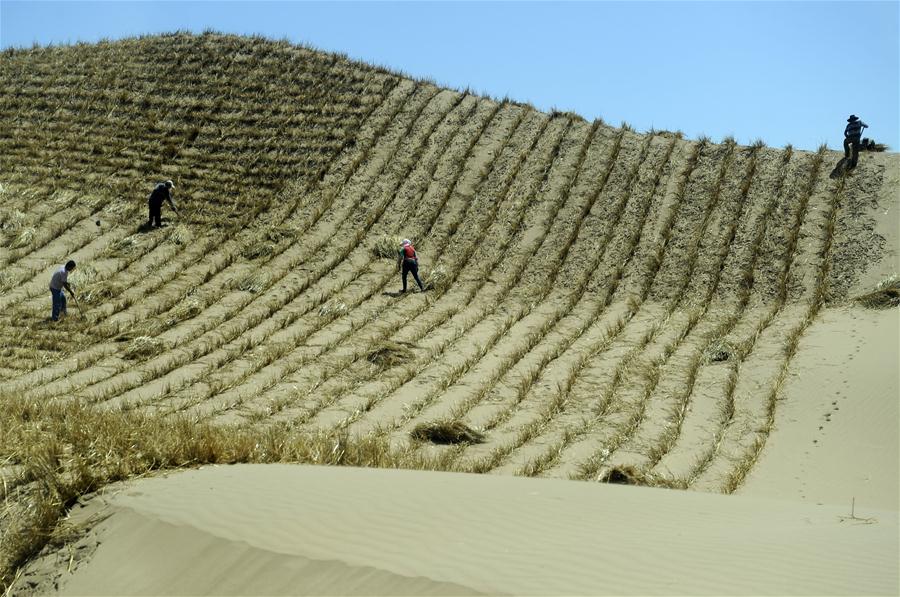
Photo taken on July 23, 2013 shows workers making straw checkerboard sand barriers in Lingwu City, northwest China's Ningxia Hui Autonomous Region. (Xinhua/Li Ran)
by Xinhua writer Jiang Tingting
BEIJING, Feb. 13 (Xinhua) -- Standing on a hillside, 46-year-old ranger Huang Xiaobin looks down at the lush landscape that surrounds his village in the remote mountainous areas of the southwestern Jiangxi Province. Terraced slopes that were once barren are now filled with cedars and pine trees.
The landscape has changed a lot since Huang's grandfather, the first ranger in his family, took the job in 1951. At that time, the fields were just sparsely dotted with bushes.
Inspired by the idea of turning barren hills to green ones, Huang's father and Huang picked up the batons in succession.
"The landscape looks completely different," said Huang Xiaobin, who has spent 25 years planting trees and taking care of the forest. "It's worthwhile," he said simply, despite the harsh environment and heavy workloads.
Thanks to hundreds of thousands of devoted rangers like the Huang family, China has made huge headway in reforestation over the past decades, contributing enormously to global efforts in fighting soil erosion, air pollution and climate change.
NASA DATA
A new study using data from NASA satellites shows that China and India are leading the increase in greening on land and concludes that the "effect comes mostly from ambitious tree-planting programs in China and intensive agriculture in both countries." The study was published on Feb. 11, 2019, in the journal Nature Sustainability.
The researchers found that global green leaf area has increased by 5 percent since the early 2000s, an area equivalent to all of the Amazon rainforests. At least 25 percent of that gain came in China.
With almost 1.4 billion mouths to feed, China needs both the land and the timber to fuel its economy. China's contribution to the global greening efforts comes in large part from its vigorous programs to conserve and expand forests.
China aims to increase the forest cover to 23.04 percent by 2020, and to 26 percent by 2035.
To achieve the ambitious goals, the country has taken a slew of measures ranging from reforesting hillsides to creating protected grassland and nature reserves.
UNSWERVING EFFORTS
After several decades of blistering economic growth, China has realized the damage on the environment and begun to pursue a greener path forward.
Reiterating that "lucid waters and lush mountains are invaluable assets," Chinese leadership has stressed that the country must embrace eco-friendly models for growth and ways of life.
Over the past three years, 44.67 million hectares of state forest farms have been protected. Logging of natural forests has been strictly banned. Consumption of natural forests has fallen 5.56 million cubic meters annually.
The government has also conducted regular quality tests of tree seedlings and established a nationwide resource database of robust seedlings in a bid to ensure that healthy seeds are restored and used.
PUBLIC PARTICIPATION
The notion of the eco-friendly way of life has resonated with the aspiration of the general public, with many individuals actively participating in various greening campaigns.
One of the most popular programs is "Ant Forest," which was launched in September 2017 by a Hangzhou-based company, Ant Financial Services Group, which has become a feature in the Alipay app, one of the most widely used online payment platforms in China.
Users can claim carbon points for doing environmentally-friendly things such as walking, using public transportation, going paperless in the office and more. These points can then be used to water and grow their own virtual saplings. After the virtual saplings have grown to become virtual trees with the constant watering of carbon points, Ant Financial and their charity partners will plant real trees somewhere in the world.
By the end of May last year, the number of Ant Forest subscribers had exceeded 350 million, reducing exhaust equivalent to 3 million tonnes of carbon dioxide. More than 55 million trees had been planted and attended.
"Such programs are quite appealing to me. I feel satisfied to see a real tree planted just by doing some simple things such as riding bicycles and buying tickets online," said Zhang Jing, a 28-year-old salesperson.
GREAT BENEFITS
China's reforestation efforts are paying off, with improved biodiversity and a healthier economic growth model achieved.
Last year, researchers from the Beijing Normal University documented the presence of several rare animal species in the Ziwuling Forest Area in Yan'an, northwest China's Shaanxi Province. Sightings of the animals, including leopards, the golden pheasant and roe deer, which once disappeared from the region, caught on tape.
Dense forests have also become a great source of revenue for locals. Saihanba, a vast man-made forest covering about 93,000 hectares in north China's Hebei Province, 400 km north of Beijing, is a case in point.
Over the years, Saihanba Forest Farm has developed in a sustainable way, with economic growth relying on tourism, tree planting, wind power generation and logging. The greening sectors brings in over 600 million yuan (about 89.55 million U.S. dollars) annually, outweighing the revenue from logging operations in the past, data show.
Forest parks are now popular attractions of tourism in the country. Last year, tourists made 1.6 billion trips to forest parks across the country, and forest-themed tourism has become a third pillar of the forestry industry, said Cheng Hong, a senior official with the National Forestry and Grassland Administration.
(Video editor: Liu Xiaorui)