
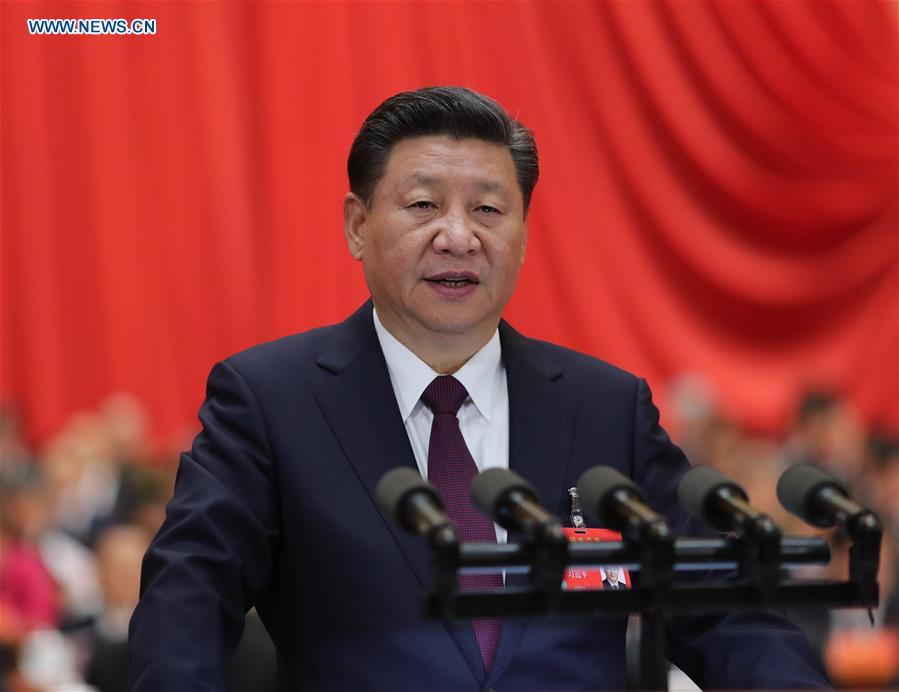
Xi Jinping delivers a report to the 19th National Congress of the Communist Party of China (CPC) on behalf of the 18th Central Committee of the CPC at the Great Hall of the People in Beijing, capital of China, Oct. 18, 2017. The CPC opened the 19th National Congress at the Great Hall of the People Wednesday morning. (Xinhua/Ju Peng)
By Xinhua writer Xu Lingui
BEIJING, Oct. 20 (Xinhua) -- Everyone who followed Xi Jinping's speech at the opening of the 19th National Congress of the Communist Party of China (CPC) got the message loud and clear: A new era has begun.
Central to Xi's declaration that socialism with Chinese characteristics has entered a new era, was his statement that the "principal contradiction" facing Chinese society, a maxim that has stood for 36 years, has changed. It is a shift that "affects the whole landscape."
The "principal contradiction" is a term most Chinese are familiar with from grade school, but only a tiny number of foreigners, experts in sinicized Marxism will know this seemingly obscure piece of political jargon.
Marxists interpret the world through dialectical materialism. Contradictions -- or "dynamic opposing forces" -- are omnipresent in society and drive social change. The "principal contradiction" is what defines a society. By identifying and solving it, society develops peacefully. Left unsolved, it can lead to chaos and eventually, as Marx predicted, to revolution.
Since coming to power in 1949, the CPC has identified the principal contradiction, and, as the times changed and contradictions changed, crafted new policies in response.
Soon after 1949, it was "the people versus imperialism, feudalism and the remnants of Kuomintang forces" which evolved into "proletariat versus bourgeoisie," a mentality which led to prolonged social turmoil across the country.
In 1981, the CPC changed its assessment of the principal contradiction to "the ever-growing material and cultural needs of the people versus backward social production," a historic policy shift at the heart of reform and opening up. Developing the economy, mainly through growth, was thus endorsed by the CPC as the "central task." Market economic reforms, seen at the time as a magic bullet to transform production, were unleashed on an unprecedented scale.
The rest is a history we all know well. The Chinese economy grew to the second largest in the world, expanding by about 10 percent each year for more than three decades. China became the world's factory floor. Consumer goods, which were hardly ever seen in the country in 1981, are now abundant.
The Made-in-China list today grows ever longer, its products more sophisticated. From finger nail-sized computer chips to jumbo jets and high-speed trains, the world's factory is now the world's laboratory and marketplace. Giant Internet companies have emerged, with booming consumer demand satisfied through the most advanced mobile technology. The era of "backward social production" is well and truly over.
"What we now face is the contradiction between unbalanced and inadequate development and the people's ever-growing needs for a better life," Xi said.
But with wealth comes new desires: an education at Oxford or Cambridge, a California vacation, a villa in Sydney.
This demand for a better life overseas is derived from an inability to satisfy these desires at home. The very highest level of education is not available or in acute short supply. There are long waiting lists in the very best hospitals. Tourist sites are crowded and services there have hardly advanced at the same pace as people's expectations.
Despite huge improvements, smog remains an obvious problem. A store inside the Jingxi Hotel in downtown Beijing, where many Party delegates stay during the congress, sells face masks, including a type with an electric filter priced at 398 yuan (60 U.S. dollars). "For your health, please wear a mask on smoggy days," a sign reads. Taking a stroll outside Jingxi, one finds old, nondescript apartments selling for more than 80,000 yuan per sq meter.
"The needs to be met for the people to live a better life are increasingly broad. Not only have their material and cultural needs grown; their demands for democracy, rule of law, fairness and justice, security, and a better environment are increasing," Xi said.
Serving the majority of the people is what distinguishes socialism from capitalism, which only protects the interests of a selected few, Karl Marx said some 150 years ago. Common prosperity is the hallmark of socialism.
Development between various Chinese regions varies sharply. In southwest mountainous Guizhou Province, whose delegates were joined Thursday by Xi in a panel discussion, household incomes remain very low.
When a delegate told Xi that a local liquor sells for only 99 yuan, he said "That's not cheap! ... It may not be so popular if it gets too expensive."
The average income in Guizhou was 15,121 yuan last year, less than a third that in Shanghai.
The gap in personal wealth between the haves and the have-nots is of no less concern. The country's three richest men -- two Internet gurus and one property magnate -- are each worth more than 30 billion dollars according to the latest Hurun rankings. Meanwhile, millions of people struggle to get by on less than a dollar a day.
CPC policy aims for more balanced, better quality development across regions and sectors and is expected to remain that way for some time to come, perhaps until the principal contradiction shifts again.
Xi does not mince his words. China, he said, will remain in the primary stage of socialism for a very long time. China's international status as a developing country has not changed.
His two-stage development strategy spans 30 years, with the objective of making China a "great modern socialist country" set for the middle of the 21st century.
Only a prosperous, strong, democratic, culturally advanced, harmonious, beautiful China will be ready to cross the threshold into the next stage of socialism.